
Part IV. What would make you change your mind? Chapter ten.
The Same Three Letters
Contents of Grounds
On a card is written UGA. Dana knows it is a codon — a triplet of nucleotides in RNA, denoted by three letters. Timur remembers this triplet from the school table of the genetic code.
“Stop,” he says. “Protein assembly ends here.”
Dana turns the card over. On the back it says: “Read in human mitochondria.”
“And now?”
Timur looks at UGA once more. The letters stayed the same. But the note on the back is part of the problem, and it must be allowed for.
How three letters are read
In protein synthesis the ribosome reads information off messenger RNA. Its record uses four letters: A, U, G and C. They are read in triplets, starting from a fixed place. In our problem one whole codon is already picked out — UGA.
From four letters 64 triplets can be made. In the standard table of the genetic code, 61 codons match amino acids of twenty types, and three codons mark termination. So several different codons may match one amino acid.
UGA in this table is one of the stop codons. Usually it signals the synthesis of the polypeptide chain, from which a protein forms, to finish. The assembled chain does not break in the process: its assembly ends.
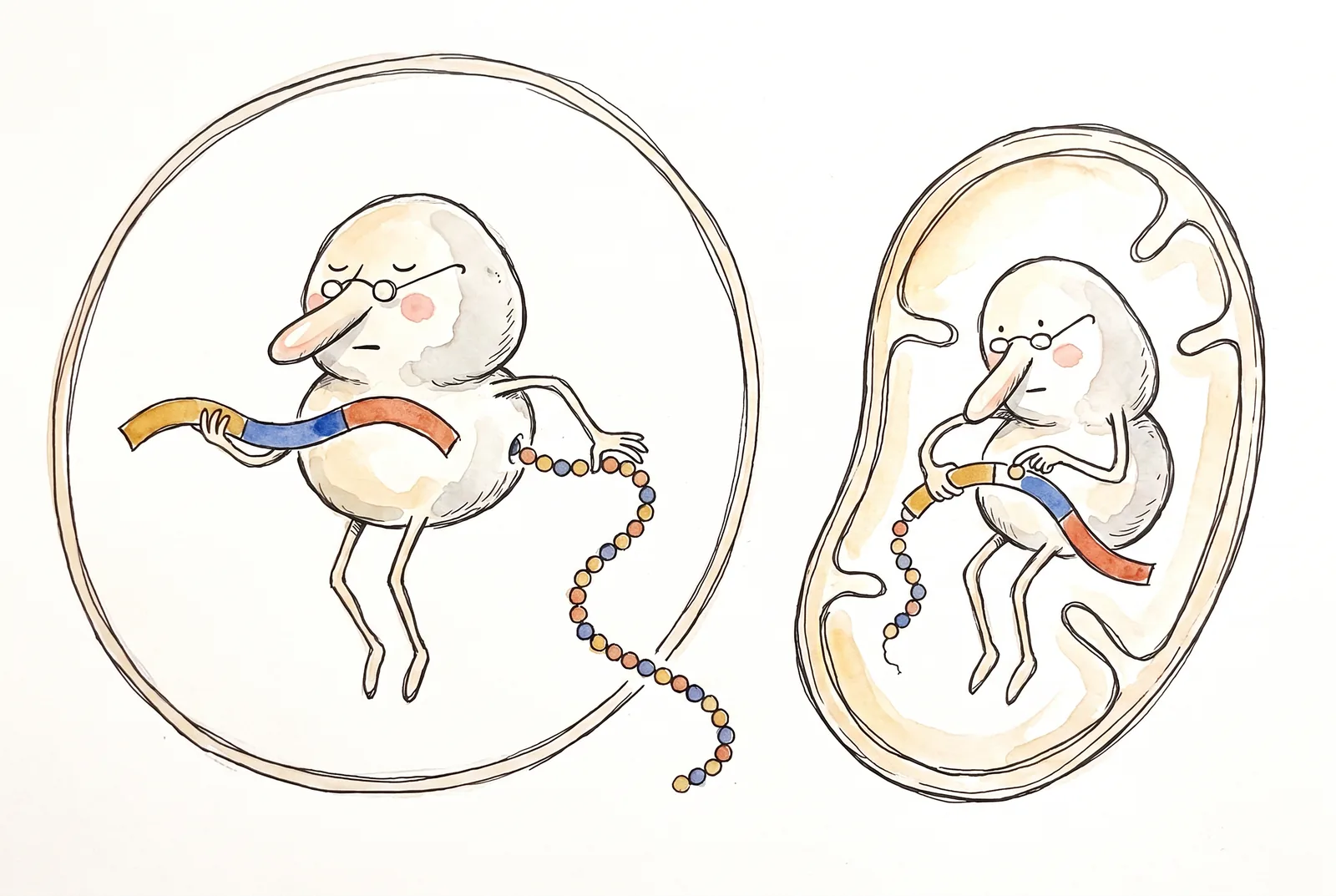
But the standard table does not cover every variant of the genetic code. Mitochondria are intracellular structures with their own DNA and their own protein-synthesis machinery. Some codons in protein synthesis off mitochondrial genes read differently.
In the vertebrate mitochondrial code, humans included, UGA matches tryptophan — one of the amino acids. At that place the next link joins the chain. In the NCBI tables the standard code carries number 1, the vertebrate mitochondrial code number 2.
Now it is clear why the card’s back was needed. Timur recalled the right row of the standard table but had not yet established whether it fits this entry. For the case stated on the card the answer is tryptophan.
If the back is blank
Take the note away. Before us again is only UGA. We know it is a codon, but we do not know in which system it is read.
We may answer conditionally: in the standard table it is marked as a stop codon, in the vertebrate mitochondrial table as a tryptophan codon. But picking one assignment for our card from these three letters alone is impossible.
“Not established” here does not mean “UGA cannot be a stop”. Nor does it mean “so it is tryptophan”. We know of different matches but lack the information to apply one of them to the particular case.
Two situations must be told apart. In the first, the biological context is unknown. In the second, it is established and points to another assignment of the codon. The first needs more information. The second needs the answer changed.
Mixing these situations up, it is easy either to invent the missing part or to miss the meaning of information already received. Timur might keep insisting on “stop”, citing the textbook. The textbook’s row would be no wronger for that, but another table would still apply to the card.
The table describes what happens
In the Pluto chapter we also picked the rule the answer depended on. But here the ground for picking is different.
The International Astronomical Union set the criteria of the “planet” category. Observations help determine whether a heavenly body meets them. The genetic code table describes matches that researchers uncover while studying protein synthesis. No decision can make a mitochondrion read a codon differently.
Of course, people invented the letters, the names and the table numbers. But behind the entry UGA → tryptophan stands a checkable claim about a biological process. It does not become true because such an answer suits us.
So for the card, picking a favoured table is not enough. We need to find out where and how the RNA is read, and use the description matching that system. If a table’s prediction diverges from observations, check both the information about the system and whether the description itself suffices.
What became known in 1979
On 8 November 1979 the journal Nature published the paper “A different genetic code in human mitochondria”. Its authors compared the sequence of a human mitochondrial gene against the amino-acid sequence of the matching protein from bovine heart. This analysis showed UGA used as a tryptophan codon, not as a synthesis-termination signal.
The publication did not change how mitochondria work. It reported a difference that had been found. The paper’s date belongs to the history of our knowledge, not to the start of a new biological rule.
Here recall the interlude’s question: what information was available when the conclusion was drawn?
Observations in studied systems might give grounds to expect familiar matches to hold elsewhere too. Such an expectation may be a sensible working hypothesis. But the claim “UGA always means stop, in any system” is far stronger. Carrying a result over to cases not yet studied needs grounding.
So the date alone cannot judge whether earlier conclusions were well grounded. We need to know what exactly the researcher claimed, what data he rested on, and how widely he spread the conclusion. Nor does one publication date mean everyone knew of it the next day.
New information lets a generalisation be revised. That needs no giving up of correctly described cases. It suffices to admit that the old wording covered more than its grounds allowed. And the refined claim has a narrower meaning: the word “always” is gone from it.
That is how grounding and truth differ. From the available information a person might have serious grounds for an assumption that later failed. New data helps see its boundary but does not make the old mistaken forecast right retroactively.
What changed in the answer
Timur adds to the word “stop”: “in the standard table”. Below he writes the card’s answer: “tryptophan”.
“Two answers now?” he asks.
“Two matches. The card states one case,” Dana answers.
The UGA letters did not change. What changed is our understanding of which process they belong to. Without the note we could name possible matches. With the note we gained grounds to pick the needed one.
The answer grew precise thanks to particular information. But from this it does not follow that any claim can be saved by adding hedges. Sometimes its scope of application must change; sometimes it must be admitted false. The condition must reflect the studied system’s workings and be backed by data.
In the next chapter three signs will converge on one conclusion. We will work out whether they give grounds to trust it and what is missing for checking.