
Part II. What exactly are you claiming? Chapter six.
It Can Be Said Shorter

Contents of Grounds
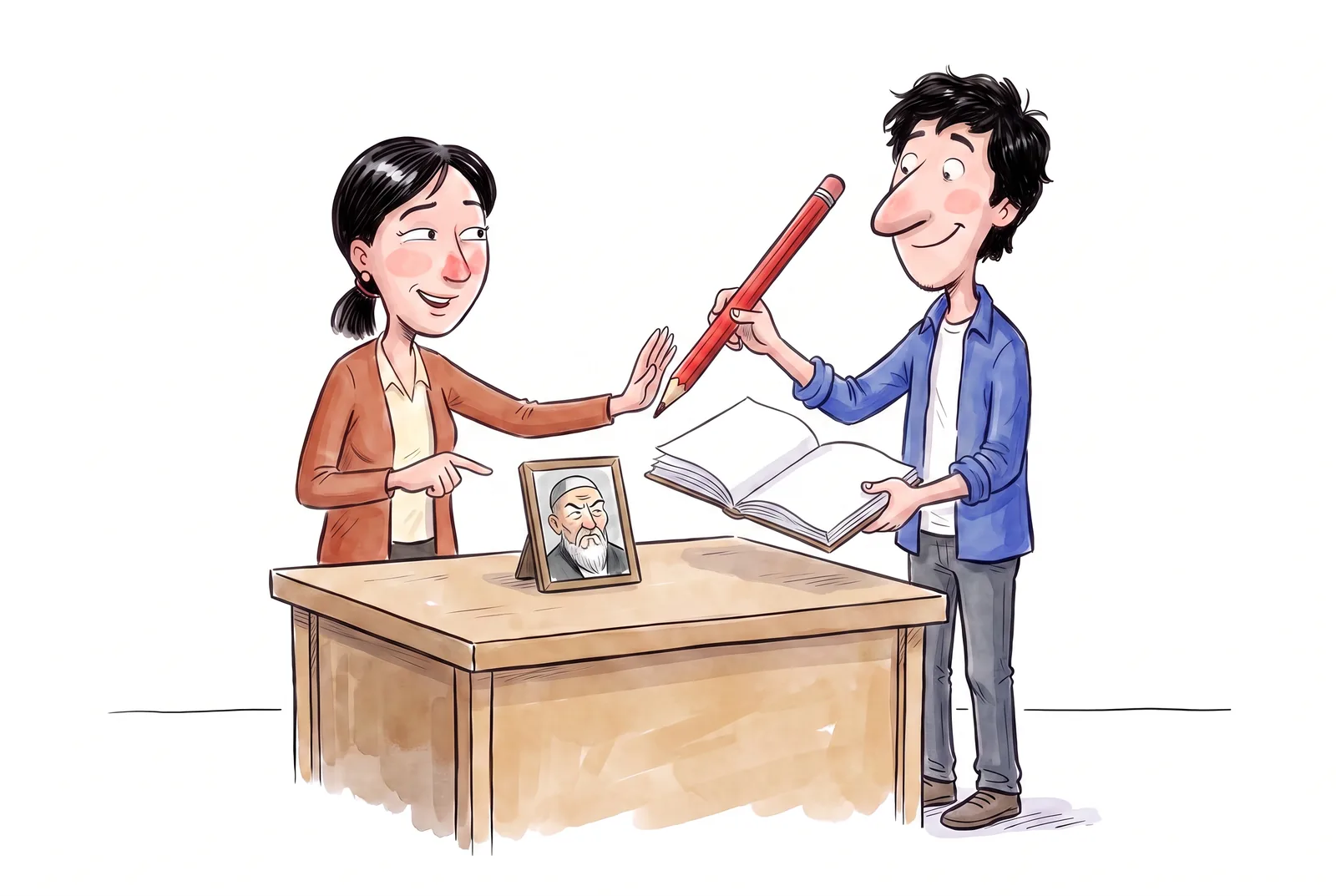
Timur reads aloud Abai’s quatrain, the one assigned for homework. The first line in the book runs: “Talai söz budan buryn köp aitqamyn.” Reaching the last word, Timur says “aitqanmyn”.
“It says aitqamyn,” Dana notes.
“That is just the short form. The correct one is aitqanmyn.”
“Are you reading the poem — or correcting it?”
Timur looks at the book. He only meant to prepare well for the lesson. Instead, Abai has ended up sitting a spelling test.
Two forms side by side
In Kazakh some verb forms live both in full and in shortened shape. Take baramyn and baram (“I am going”), kelip qaldy and kep qaldy. Such variants turn up in speech and in literature alike. Shortening alone does not yet make a form wrong.
Rabigha Syzdyq takes apart these cases in the “Söz sazy” section of her Kazakh language reference. The section covers orthoepy — pronunciation norms. §33 lists full and shortened forms, then gives a direction for reading aloud: keep the variant the text uses.
If baram is written, it needs no expanding into baramyn. If baramyn is given, it should not be shortened to baram at will. The direction works both ways. The full form gains no advantage just for holding more letters.
That is no demand to pronounce everything letter by letter. Spoken speech follows its own sound patterns. The narrower question here is whether one verb form may replace another in reading aloud.
Now Timur’s mishap is clearer. He recognised the shortened form but decided it had to be restored. The exercise, though, asked him to read the given text aloud. The reference cites Abai’s quatrain precisely for practising such reading.
What changes in the verse
The shortfall could be blamed on metre: the poet ran out of room, shortened the word, and Timur put the extra syllable back and spoiled the line. A handy explanation, but wrong for this pair. Aitqamyn and aitqanmyn hold three syllables each. A shorter word need not hold fewer syllables.
Keeping the form in reading aloud needs no guessing why the poet picked it. This text holds aitqamyn, and the rule says to render that variant. The artistic effect may be discussed apart. Its answer will take other arguments than “the full form is more correct”.
But there are cases where shortening does tie to metre and rhyme. The reference’s next paragraph takes apart forms like tildesedi and esedi. The third-person ending -dy or -di under the stated conditions may shorten to -d; a final-t pronunciation turns up too: tildeset, eset.
The example given is Asset’s poem “Inju-marjan”. There the shortened forms help hold eleven-syllable lines and rhyme with the name “Asset”. Here the tie to the verse’s workings is explained straight in the source.
And Syzdyq mentions such shortenings not only in verse but now and then in prose too. So a plain border of “allowed in verse, banned in prose” will not hold. The particular use and the reference’s stated conditions must be allowed for.
One more distinction: a permission to shorten a form does not demand shortening it every time. From an author’s power to use the device it does not follow that a reader may redo every ending he meets. An author composing a line and a person reading it aloud have different tasks.
Four questions instead of one
What did Timur mean by “correct”? Swap it for sharper questions.
Do people say so? That is a question of usage. A form may be heard in conversation, found in a speech record or a literary work. Such observations show it exists. But one fact of usage is not enough to count it fitting for every text.
Is it accepted to speak or write so in this situation? Here we turn to norm and communication conditions. The literary norm covers speech and writing both; a document, a conversation and a poem’s performance may ask different things. It cannot be decided in advance that the full form is always standard and the shortened one always outside the norm. That must be checked against a fitting source.
How to read the given text? This question belongs straight to Timur’s lesson. For the forms at hand §33 gives a definite direction: keep the full or shortened variant the text uses. That another situation might allow another form does not cancel the reading task.
What does the choice give the author? That is a question of expressiveness. Shortening may build rhythm, carry a rhyme, or render a character’s voice. But the explanation must be sought in the work itself. No shortening’s cause may be declared to be metre, as we nearly did with aitqamyn.
These questions connect, but their answers do not replace one another. A pronunciation reference will not explain every poetic design. A found example will not prove a form fitting for all situations. And a remark on official writing will not yet tell how to perform a poem’s line.
The eager corrector
There is nothing unusual in Timur’s intent. The better we memorise a rule, the readier we are to apply it everywhere. A short form looks incomplete, and the hand itself reaches out to add the missing letters.
But before correcting, we must understand whether there is a mistake. We may face an allowed variant. Or a character’s voice. Or a mistake may truly be there — only taking the particular case apart will establish that, not distrust of everything short.
Timur reads the line once more, now with aitqamyn.
“So the full form is wrong?”
“We are talking about this line. It holds aitqamyn. That is what we read,” Dana answers.
This small refinement keeps us from a new extreme. We do not swap the “expand everything” rule for an “shorten everything” one. We learn to notice which task each direction belongs to.
Before correcting
In the last chapter the word “acid” hid different definitions. Here the word “correct” turned out to hold questions of usage, norm, reading aloud and artistic choice. We divided them and got an answer to one particular question: how Timur should read the line before him.
That took two supports. First we looked at which form the text gives. Then we found the rule for reading it aloud. One rule without the text would have been too little: we would not know which variant to keep. One text without the rule was not enough for Timur either — he saw the shortening and decided to fix it.
Refining need not end every dispute. But it shows which information may change the answer. If another edition holds another form, the editions will have to be taken apart. If we write our own letter, a rule for that task will be needed. A ready answer may not be carried over while the conditions it was got under go unattended.
In this part of the book we worked out what exactly we claim. Next we will ask why it may be believed. But before moving on, stop at one more detail: as of which date does our information hold.