
Part III. Why should this be true? Chapter eight.
A Triangle on Paper
Contents of Grounds
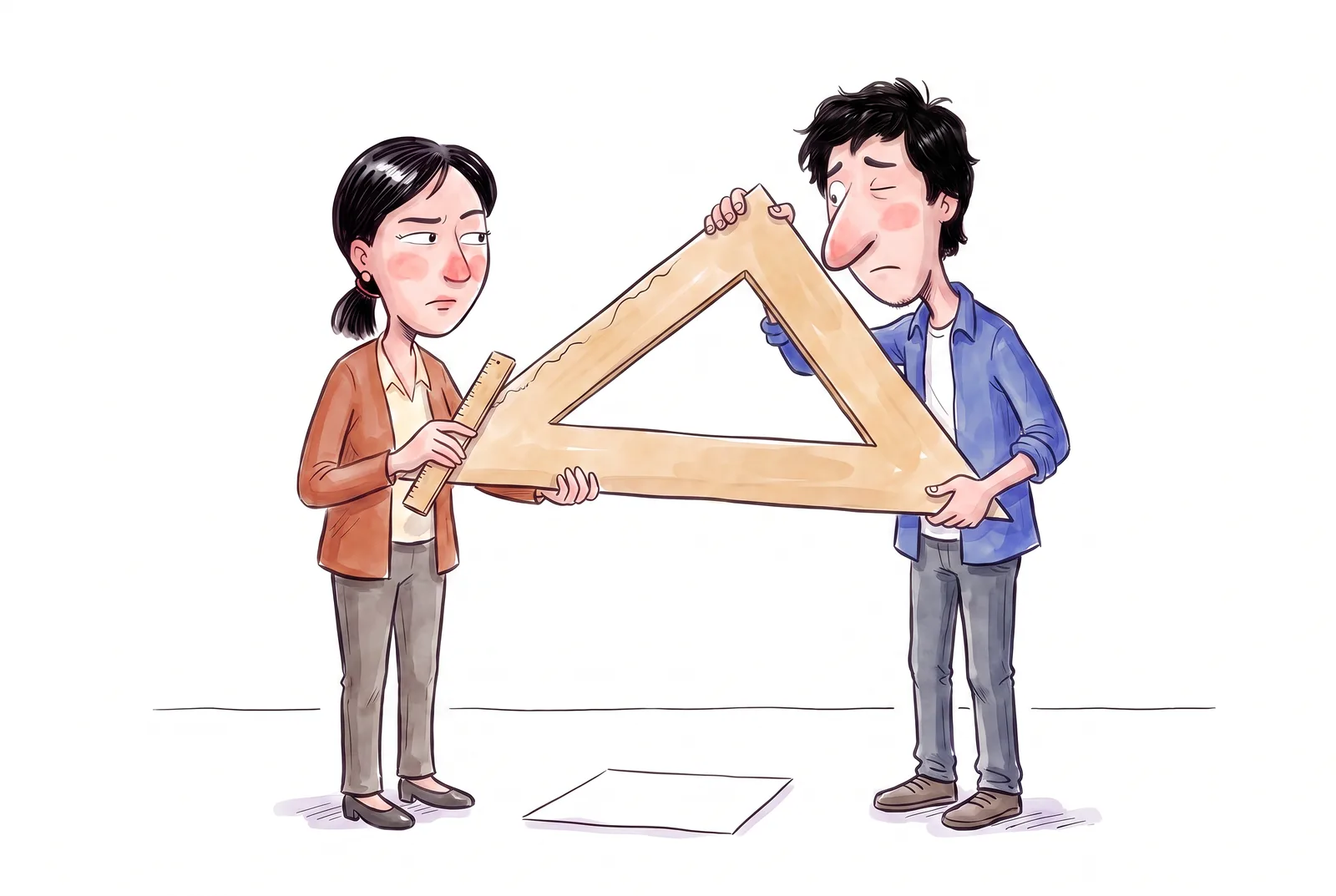
On a sheet of paper a triangle is drawn. One angle looks right. Dana holds a set square to it: it seems to fit. Timur takes a ruler and measures the sides. Three centimetres, four and five — as far as the markings tell.
“Right-angled,” he says. “Three, four, five. A classic.”
“And if the last side is a touch longer than five?”
“Then measure more precisely.”
Measuring more precisely is indeed possible. But even the best ruler cannot do one thing: turn a measurement result into an exact condition of a mathematical problem.
Look, measure, state
First Dana looked at the angle and held the set square to it. That gave her grounds to count the angle as close to right. How close depends on the instrument, the lines’ thickness, and the care of comparison. One “seems to fit” is not enough for an exact estimate.
Then Timur measured the sides and checked the familiar equality:
3² + 4² = 5², that is 9 + 16 = 25.
The computation is right. But it took in rounded measurement results. We do not yet know how far they stray from the lengths we try to determine. The agreement of these numbers’ squares does not yet prove the angle on the sheet to be exactly 90°.
Now set another task. Consider a triangle on the Euclidean plane whose sides are exactly 3, 4 and 5 units of length. They may be stated in centimetres too: what matters is that these are exact conditions, not ruler readings.
For such a triangle the equality holds exactly. By the converse of Pythagoras’s theorem the angle opposite side 5 is right. Neither pencil-line thickness nor set-square precision affects this conclusion. The drawing helps picture the triangle, but in this problem its properties are set by conditions.
Timur quietly moved from measured lengths to exact numbers. His conclusion about the mathematical 3–4–5 triangle was right. Judging the drawn angle takes returning to measurements and their uncertainty.
Which way the theorem works
Pythagoras’s theorem says: in a right triangle the hypotenuse’s square equals the sum of the legs’ squares. The hypotenuse is the side opposite the right angle; the legs are the two sides forming it.
We already know the angle is right, and get a relation of lengths. Timur went the other way: the length relation is known, and the angle is yet to be determined. That takes the converse theorem. It states: if in a triangle one side’s square equals the sum of the two others’ squares, the angle opposite that side is right.
In the Elements’ first book Euclid proves these statements apart: first proposition 47, then 48. The second uses the first but needs extra steps. Simply swapping assumption and conclusion is not enough.
In our example both directions are proved, so moving from equal squares to a right angle is allowed. Not every statement works that way. In the next chapter we meet a check built on a property of prime numbers. But it will also be passed by a number that is no prime.
But does the triangle exist?
Swap the lengths for 2, 3 and 4. Such a triangle exists, but it cannot be right-angled: 2² + 3² = 13, while 4² = 16. Were there a right angle in it, the longest side would lie opposite, and the equality would hold by Pythagoras’s theorem. It does not hold — so there is no right angle.
Here we used the direct theorem: showed the equality a right triangle needs is broken. That is a different move of reasoning than in the 3–4–5 example.
Now take 1, 2 and 3. The squares need not even be reached. The two short sides together match the third in length. Join their ends, and the vertices land on one straight line. No ordinary triangle results.
In a triangle any two sides’ sum must strictly exceed the third. Euclid proves this inequality in proposition 20. For checking stated lengths it weeds out cases where a triangle’s angles are not yet open for discussion: there is no triangle with such sides at all.
The last triple is 0, 3 and 3. Now the arithmetic looks flawless:
0² + 3² = 3².
But a triangle’s side cannot be of zero length: its two ends would coincide. The strict inequality is broken too: 0 + 3 is no more than 3. The squares agree, yet the converse theorem cannot apply. Its condition starts with the words “in a triangle”.
The difference between the examples runs deep. Sides 2, 3 and 4 set a triangle that is not right-angled. Sides 1, 2 and 3, or 0, 3 and 3, set no non-degenerate triangle at all. One same short “no” would hide different reasons for refusal.
Apply and prove
So far we have used a ready theorem. Why trust the theorem itself?
Ten right triangles can be drawn, their sides measured, their squares checked. A thousand can be drawn. Such observations help spot a pattern, but prove nothing for all triangles. Measurements are approximate, and checked cases are ever only some of all possible.
Mathematical proof is built differently. We accept starting positions and derive the statement from them step by step. In the Elements, the proof of Pythagoras’s theorem rests on constructions, properties of equal figures, and earlier proved area relations. It concerns an arbitrary right triangle in the geometry at hand.
Drawing a conclusion about the 3–4–5 triangle means applying a known result to a particular case. Proving the theorem means grounding the general move from condition to conclusion. These are different tasks.
The drawing is useful here: it helps see the construction, find the idea, or spot a missed condition. But the step “these segments are equal because they look alike in the picture” is no proof. Equality must follow from the construction or known properties.
If an exact counterexample meeting all its conditions turns up against a stated mathematical claim, hunt the error in the wording or the proof. A measured mismatch on paper needs another check: how exactly the drawing is made, what was measured, and how uncertainty was evaluated. It may refute our description of the drawing, but by itself it does not refute the theorem about exact objects.
If drawn on a sphere
Until now we spoke of the Euclidean plane. For another geometry the conditions need revisiting.
Picture a perfect sphere with an equator and poles. Run a path from the North Pole to the equator down one meridian, then along the equator for a quarter circle, and back to the pole down another meridian. The result is a spherical triangle with three right angles.
Its sides are arcs of great circles — circles whose centres match the sphere’s centre. All three picked arcs match in length. The sum of two such lengths’ squares does not equal the third’s square, though every angle is right.
That exemplifies another geometry; it is no exception to Pythagoras’s theorem on the plane. Before carrying a familiar formula onto a new object, check whether its premises survived the move.

What stayed on the sheet
“So the drawn angle is not right after all?” Timur asks.
“We did not establish that either,” Dana answers.
Now they can put it more precisely. The set square showed no visible deviation. Rounded measurements gave the 3–4–5 triple. A triangle with such exact sides on the Euclidean plane is right-angled. The last statement is proved — but it cannot retroactively make the first two observations exact.
In the last chapter correct multiplication did not replace checking the experiment. Here a correct equality does not replace checking the theorem’s premises. To feel a conclusion’s force, keep the whole path to it: what is given, which statement is applied, and whether its conditions hold.
In the next chapter the arithmetic will add up again. This time hunt the error in what we decided to conclude from it.