
Prologue.
How Do You Know?

Contents of Grounds
Around the dastarkhan — the laid table — they are discussing a trip to Burabay. The tea has been poured for the third time when someone asks:
“So how long does it take to get there?”
Answers come at once.
“Four hours,” says Uncle. “I drove it myself in May.”
“I heard three hours,” says Dana. “A colleague went last weekend.”
“The navigator says three forty,” says Timur, showing everyone his phone screen.
“Two hundred and fifty kilometres. At ninety an hour that is under three hours,” announces the younger brother. He has just done it in his head and is visibly pleased with himself.
Before reading on, decide: which answer would you rely on when planning the trip?
Each speaks with confidence, and each has something to point to: a personal trip, an acquaintance’s story, the navigator, a calculation. Behind one short answer stands personal experience; behind another, trust in someone else’s work. To compare the numbers, we must work out where each came from.
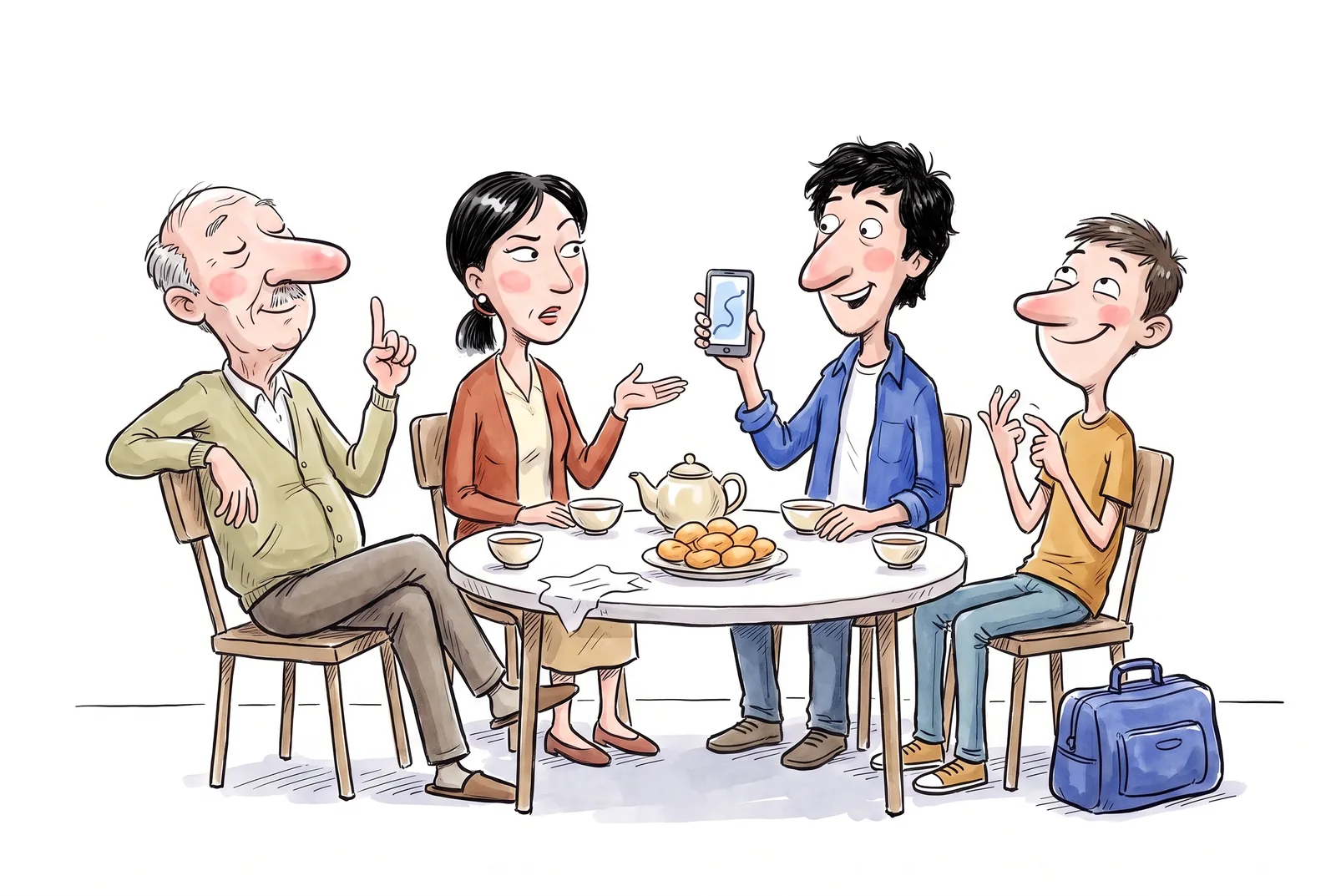
Four answers
“I saw it myself” sounds convincing. Uncle really did drive to Burabay and remembers how long the road took him. But in May there were road works near Shchuchinsk, he stopped for lunch on the way, and he was never one to hurry. Four hours is how long that trip lasted. To say how long ours will take, we need to find out which circumstances will repeat.
“I was told” points to a person who is not at the table now. Did Dana’s colleague time it herself? Did she drive at night or on a Saturday afternoon? Did she count from leaving the city or from her own front door? She may remember her trip exactly. She may have said “about three hours”, and the hedge got lost in retelling. Her story will help us if we understand what circumstances she described and how precisely she described them.
“It says so” can also settle the argument. There is the number on the screen: three hours forty minutes. But this estimate comes with conditions. Which route is selected? From where, and when, are we meant to leave? What road data is the forecast built on? Such details are easy to miss when the number you want is already before your eyes.
“I worked it out” lets us follow the younger brother’s reasoning: he divided two hundred and fifty kilometres by ninety kilometres an hour. The arithmetic is easy to check. What remains is where the distance came from and why that speed was chosen. Can it be kept on average for the whole way? Are stops accounted for? The division may be flawless, and the trip may still take longer.
Now each answer faces a question of its own. What exactly did the person observe? Where did their source get it? What situation does the written word refer to? What data and assumptions went into the calculation?
Answering these questions lays bare the grounds of a claim — what we stood on in taking it for true. Grounds can be presented, checked, and discussed. Then we see more clearly how convincing an answer is and whether it fits our task.
Familiar grounds
Such conversations happen all the time. We recall what we saw ourselves, trust other people’s stories, check textbooks and manuals. Much of what we know we never verified in person. Without other people’s experience we would start from zero every time. So it pays to understand whom we trust, and on what point exactly.
Sometimes retelling changes the very source of confidence. Monopoly has a popular house rule: taxes and fees pile up in the middle of the board, and a player landing on Free Parking takes the accumulated money. Under the basic rules that square pays nothing. But if you were taught to play it differently since childhood, it is easy to mistake a house custom for a rule from the manual.
“We always played it that way.”
A perfectly convincing account of how you know. To find out what the manual says, you will still have to open it.
A text itself has a history too. In George Orwell’s Animal Farm the commandments on the wall change bit by bit, and the animals find it harder and harder to tell what was written before. The familiar inscription no longer matches what they remember.
Texts also change for perfectly open reasons: handbooks are reissued, definitions refined, tables corrected. So sometimes naming the book is not enough. We need to know which edition lies before us and whether the passage we need applies to our case.
We meet calculations every day: working out travel time, comparing prices, adding up expenses. A written-out calculation can be repeated and checked step by step. But correct arithmetic does not yet mean we picked a fitting method and the right data. A result stands together with the conditions under which it was obtained.
One claim of your own
Recall something ordinary you are sure of. That your house was built in 1968, say. That in the mornings another road gets you to work faster. Or that saying “baram” — “I am going” in Kazakh — is wrong.
Write your claim down in one sentence and keep it. In the epilogue we will come back to it. As you read, you will learn to ask sharper questions of its grounds — the same ones we just asked around the dastarkhan. Your opinion may stay the same. Then you will understand better why you count it as grounded.
What we will do
We will take apart claims that look obvious and see what they hang on. We will swap one instrument reading and repeat a calculation. We will pin down the definition of a planet and find out why the number of planets in the textbook changed. We will check the conditions of a familiar formula. We will weigh a report about a mushroom someone confidently called edible, and take apart how that moves the conclusion. Every story offers a chance to see what supports a claim and what casts doubt on it.
Gradually we will learn to tell five things apart: what exactly is claimed; what information is offered in support; what conditions are assumed; how the conclusion was reached; what could make us revise it. The last question pays to ask in advance, while the new result is still unknown and no answer waits to be defended.
Arxo, a system for tracing how a conclusion depends on stated rules and information, will assist these examinations. We will be able to follow the course of reasoning, change an initial condition, and find out what data an answer is missing. Observing, and judging how far the initial information can be trusted, still takes separate work: a successful calculation does not confirm them by itself.
The name Arxo recalls the Greek archē — beginning, source, first principle. With time we get used to what we know and stop noticing what holds it up. The question of grounds takes us back to its sources: experience, evidence, and accepted propositions. Why do we trust them? Are they enough? What is left to find out?
Where we start
On the table lies a small part. It was measured five times, and the five readings came out different. Dana is trying to work out which one to write down. Timur suggests taking the average.
It comes out at exactly ten millimetres. A fine round number.
What do we know about the part now?