
Part II. What exactly are you claiming? Chapter four.
Pluto Went Nowhere
Contents of Grounds
Timur has two school atlases at home. In the old one, a 2005 edition, there are nine planets. Last on the list stands Pluto. In the new one, published in 2007, there are eight planets, and Pluto has moved to a neighbouring page, among the dwarf planets.
“So where did it go?” Timur asks. “Did it blow up or something?”
Nothing of the sort happened to Pluto. It kept circling the Sun on its stretched orbit while astronomers gathered in Prague and discussed what to call it. Pluto itself never found out.
Before reading on, decide: what changed between the two atlases, if Pluto never went away?

Object, observations, word
To sort it out, separate three things: the heavenly body itself, our information about it, and the category we file it under.
Pluto exists regardless of which atlas page we put it on. No decision of astronomers made it smaller, stripped it of moons, or pushed it off its orbit.
Information about it changed as observations piled up. Astronomers refined its size, mass and motion, and studied the neighbouring bodies. In the 1990s and 2000s more and more objects turned up beyond Neptune’s orbit. Among them was Eris, discovered in 2005 — a world comparable in size to Pluto. The old picture of the Solar System grew more tangled.
A question of classification arose. If Pluto is a planet, should bodies like it be called planets too? Which likenesses matter for that: size, shape, place among neighbours? The familiar list of nine names no longer showed where the boundary runs.
On 24 August 2006 the International Astronomical Union — the IAU — adopted in Prague a definition of a Solar System planet. Before that there had been no IAU-adopted definition. New observations helped raise the question, and the new definition changed the classification. That change is what our atlases reflect.
What the definition says
Here are the main conditions. Moons stand outside this division. Under the 2006 definition, a Solar System planet is a heavenly body that:
- orbits the Sun;
- has enough mass for its own gravity to give it a nearly round equilibrium shape;
- has cleared the neighbourhood of its orbit.
A dwarf planet meets the first two conditions but has not cleared its orbital neighbourhood, and is not a moon. In this classification planets and dwarf planets form different categories. All other bodies orbiting the Sun, moons excepted, count as small Solar System bodies.
The word “cleared” does not mean the surroundings must be perfectly empty. It means the body has come to dominate its orbital zone through mass and gravity. Planets may keep neighbours. Pluto fails this condition, though it orbits the Sun and is nearly round in shape.
The IAU separately stated that Pluto belongs to the dwarf planets under the adopted definition. And a footnote to the definition listed the eight planets: Mercury, Venus, Earth, Mars, Jupiter, Saturn, Uranus and Neptune.
Here two ways of grounding an answer appear. To learn which category the IAU assigned to Pluto, we can turn to the resolution itself. To see why it meets that category’s conditions, we need information about its properties. Citing the resolution settles the accepted classification but does not replace explaining its grounds.
A body not fully known
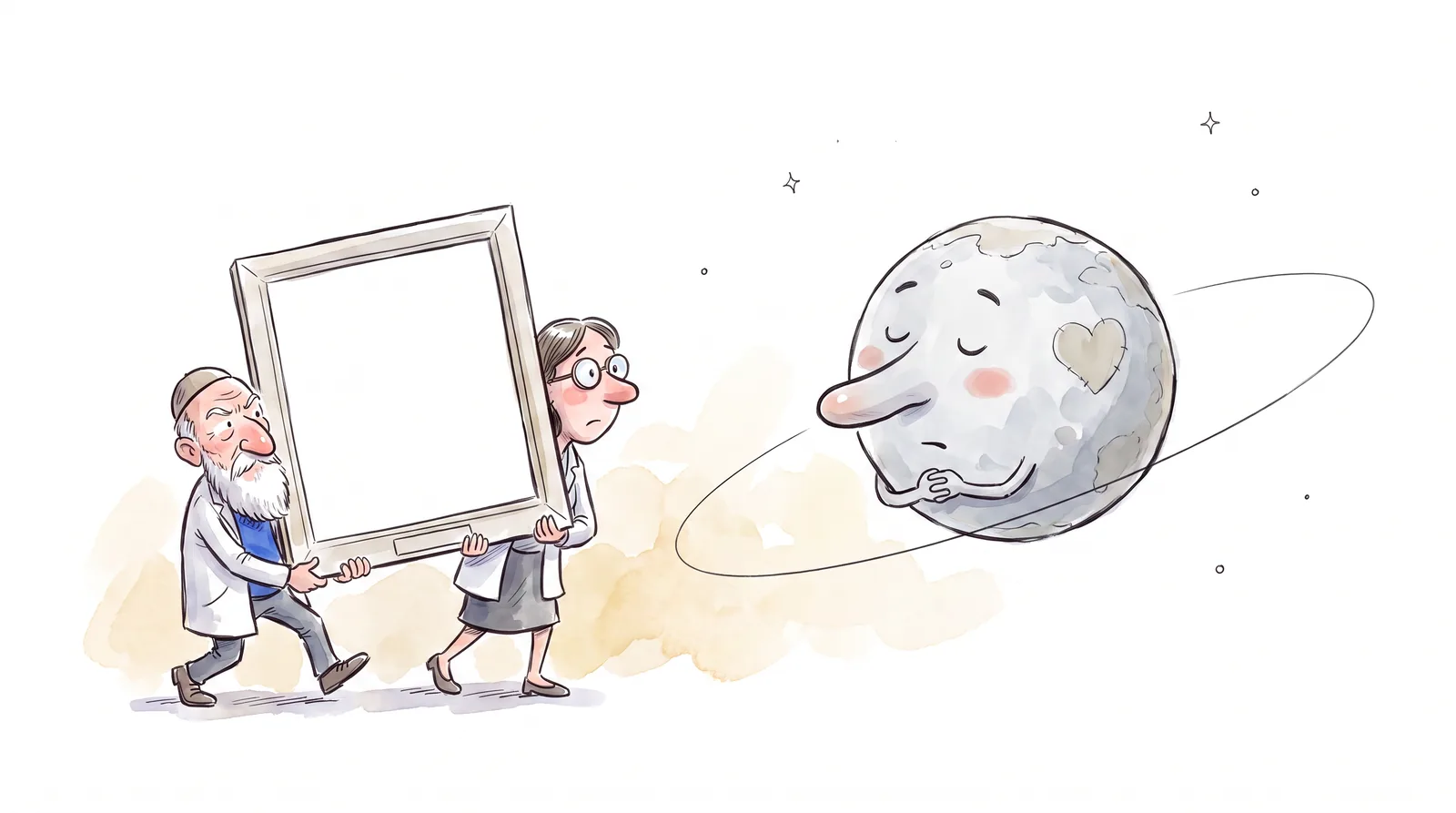
Now imagine another body, found beyond Neptune’s orbit. It is known to orbit the Sun, to be no moon, and to have enough mass for its own gravity to have given it a nearly round equilibrium shape. About its orbital neighbourhood there is no information yet.
Timur wants to send it straight to Pluto’s page. It looks alike, after all.
But under the stated conditions the answer turns on whether the body cleared its orbital neighbourhood. Outward likeness does not settle that. And no information about clearing does not mean the neighbourhood is uncleared. We do not yet know whether the needed condition holds.
So the answer runs: on the available information, it is not established whether the body is a planet or a dwarf planet. That is no new category of heavenly bodies. It describes what we know.
Such an answer beats a guess: it points at the information needed for the next step. The body’s surroundings and its gravitational pull on neighbours remain to be studied. Hand a machine the written definition plus only the stated information, and the correct output is the same: too little data to pick a category.
We will keep coming back to this distinction. There can be grounds to confirm a claim, grounds to refute it, or too little information for either. The last must not be turned into a negative answer just to fill a row in the table.
As of which date
Back to the 2005 atlas. Did it become wrong retroactively? The 2006 resolution itself does not make its earlier entry a mistake. A list of nine planets matched the then-accepted classification. In the new atlas the editors used the IAU definition and got a different list.
Comparing these books, it helps to ask which classification each uses and which time its account refers to. If the 2007 atlas promises to follow the 2006 IAU definition yet counts Pluto among nine planets, that is an inconsistency. But a year on the cover alone cannot judge a whole book’s contents: it may, say, narrate the history of astronomy.
Keep the old atlas, and furnish the new edition with an explanation of the change. Then the reader will see why the answers differ, and will not mistake a classification change for a heavenly body’s disappearance.
A definition has an adoption date, information has a time of arrival, a book has a publication year. These dates answer different questions. Between parts two and three we will take them apart in more detail. For now remember: comparing answers means pinning down both the time and the rules they were got by.
What we know now
Timur asked where Pluto went. The short answer: nowhere. Dana opens both atlases at the wanted pages. On one, Pluto joins the familiar list of nine planets; on the other, it counts as a dwarf under the 2006 definition. Now it is clear why the captions differ.
Picking a category rests on which properties of objects we count as essential for comparing them. Applying a definition needs information about those properties. In Pluto’s story, observations prompted the classification’s revision. The astronomers’ decision fixed how the terms are used.
But work remains even after a definition is adopted. How to establish that gravity gave a body its equilibrium shape? What data judges the clearing of orbital neighbourhoods? Near Jupiter’s orbit, say, asteroids travel — yet their motion is tied to its gravitational pull, and their very presence does not strike Jupiter off the planets. One literal reading of the word “cleared” is not enough here.
The resolution provides for a procedure to assign borderline objects to dwarf planets or another category. This footnote holds no ready procedure. The definition sets conditions, and checking them takes observations and scientific work.
So the question “where did Pluto go?” leads to another: what exactly do we claim when we call an object a planet? In the next chapter we go further and take apart a word with three definitions at once.