
Part IV. What would make you change your mind? Chapter thirteen.
A Dombyra Owes Fux No Exam
Contents of Grounds
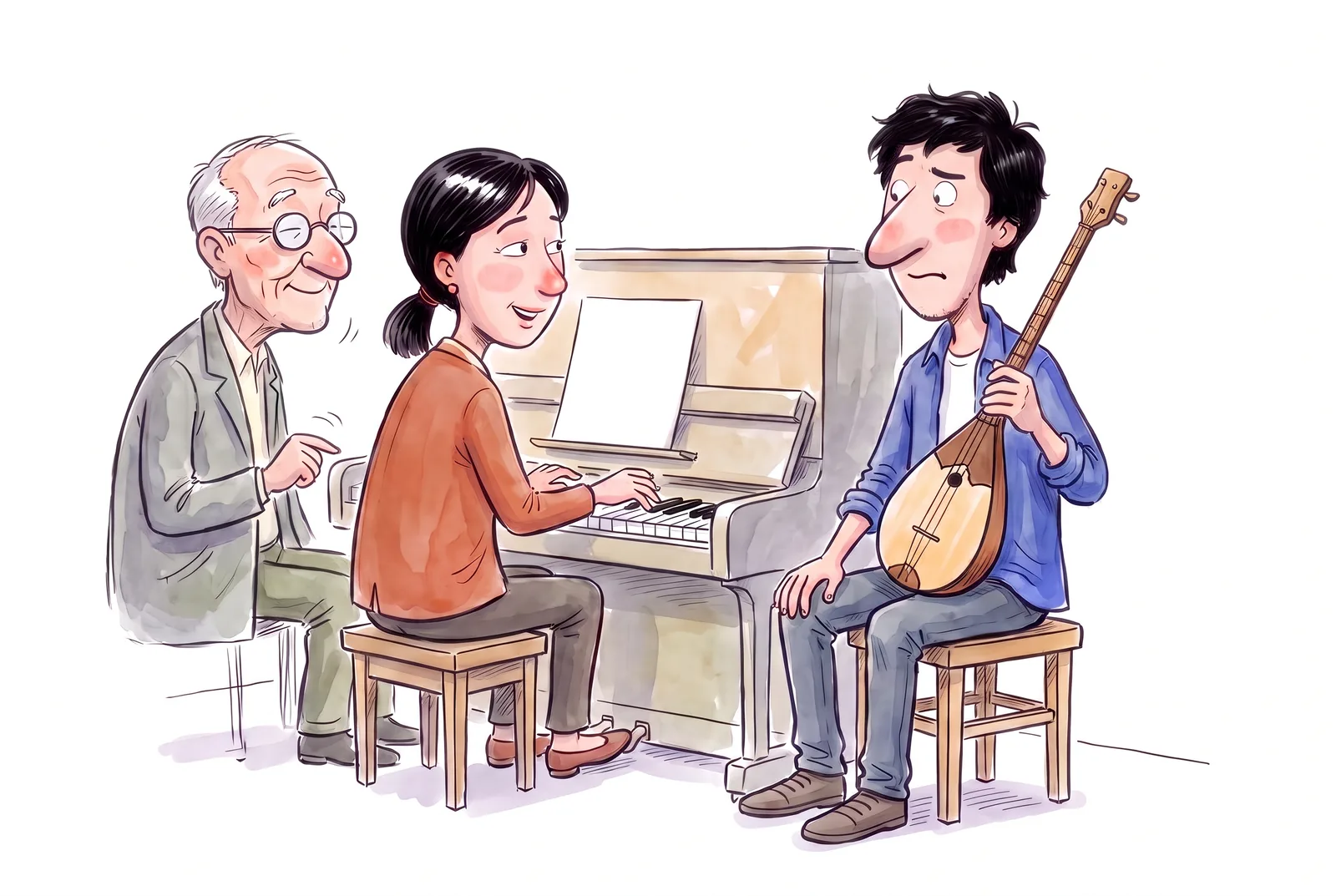
In music-theory class Dana lays a two-voice exercise on the stand. The lower melody is set by the teacher; the upper she composed herself. Each note of the lower voice matches one note of the upper — this way of building is called first-species counterpoint, or “note against note”.
The teacher looked the work over: the assignment’s demands are met. Dana plays the exercise on the piano.
“So it turned out well,” she says.
Timur, who plays the dombyra, listens to the end.
“All correct. But I don’t like it.”
Before reading on, decide: does his answer contradict the teacher’s words?
What can be checked against the notes
Dana studies strict-style counterpoint — joining melodic lines under fixed demands. This teaching tradition ties to Johann Joseph Fux’s treatise Gradus ad Parnassum, published in 1725.
Take one demand apart: in such a two-voice exercise the voices may not move in parallel perfect fifths. To understand what that means, two consecutive harmonies suffice. This fragment takes one rule apart; it is no finished exercise.
Let the lower voice go from C to D, the upper from G to B. All four pitches sit in the first octave. First C and G sound together, then D and B.
| Voice | First harmony | Second harmony |
|---|---|---|
| Upper, original | G | B |
| Upper, altered | G | A |
| Lower, in both | C | D |
In the original, C to G is a perfect fifth. A fifth spans five steps: C, D, E, F, G, counting both ends. D to B is a sixth. No two fifths in a row here.
Now replace the upper B with A, one step down. That gives C–G and D–A: two perfect fifths in a row. Both voices rise by a tone — the lower from C to D, the upper from G to A. These are the parallel fifths banned in the picked assignment.
We can point at the exact breach: it arises in the move from the first harmony to the second. Reading the notes right and applying the rule suffices for that. A listener’s personal impression will not change the intervals.
But we checked only one move under one demand. From this it does not follow that the original meets all strict-style conditions. Nor does it follow that changing the note leaves no trace elsewhere: in the whole exercise its ties to neighbouring pitches need checking.
What “correct” means
For our scene accept that the teacher checked the whole assignment and truly found no breaches. Dana may rightly say: “The conditions are met.” That is an important result — she coped with what she learned.
But the phrase “it turned out well” may mean more. Is the exercise interesting to hear? Does the melody develop convincingly? Would you want to hear it again? Checking the set list of demands does not automatically answer these questions.
Counterpoint rules help learn to hear and build voice combinations. Following them is no empty formality. But between mastering a device and applying the device well lies the musician’s work.
So it was with the number 341. The check established a definite property, and Timur wanted a wider conclusion out of it. Now Dana makes a similar move: from meeting the assignment’s conditions she concludes the musical result is bound to be good.
Timur rejects that conclusion. He never claimed the exercise was written wrong. Nor has he said yet that it is bad: only that he does not like it.
Music can be argued with reasons
“What exactly don’t you like?” Dana asks.
Timur asks to play once more and stops her at one place.
“I keep waiting for the melody to move on. And it comes back here again.”
Now the conversation has a ground. They can look at which turn repeats, hear how it sounds in different places, and discuss what Timur expected.
Dana may answer that the return is designed: it binds the phrase’s parts. The teacher may suggest changing one turn and comparing both versions. Then it grows clearer what the repeat gives — wholeness or a sense of sameness.
The repeat’s bare fact can be checked against the notes. Its expressive meaning takes other reasoning: the place in the phrase, the performance and the design must be allowed for. From “the turn is repeated” it does not follow that “the music is dull”.
Some musical demands can be stated exactly and put into a check. Others allow several convincing solutions. That does not make discussion pointless: the speakers may present examples, compare performances and revise estimates.
A teacher’s experience helps notice what a pupil still misses. But citing the teacher does not replace his reasons. Hearing what exactly he counts as good, and why, beats getting one more unexplained “fine”.
Taste can be explained too
In Dana and Timur’s dispute three questions tangled: whether the work meets the assignment, how well it is made, and whether a particular listener likes it. They connect, but an answer to one does not replace answers to the rest.
A personal impression need not be unaccountable. Timur can explain what he likes in music, which motion he awaits, and what tires him. These words will help Dana understand his reaction, though they will not oblige her to feel the same.
He may also simply say “don’t like it”, offering no analysis. That reports his present impression. Moving from it to “the exercise failed” takes more grounds and an understanding of which signs mark success.
Knowing the design or another performance may change the impression. It may not. A person can appreciate mastery and still not love a work. There is no contradiction here for one more check to remove.
What the dombyra has to do with it
After the exercise Timur takes the dombyra and plays a familiar kui. Dana listens, no longer checking against the demand list.
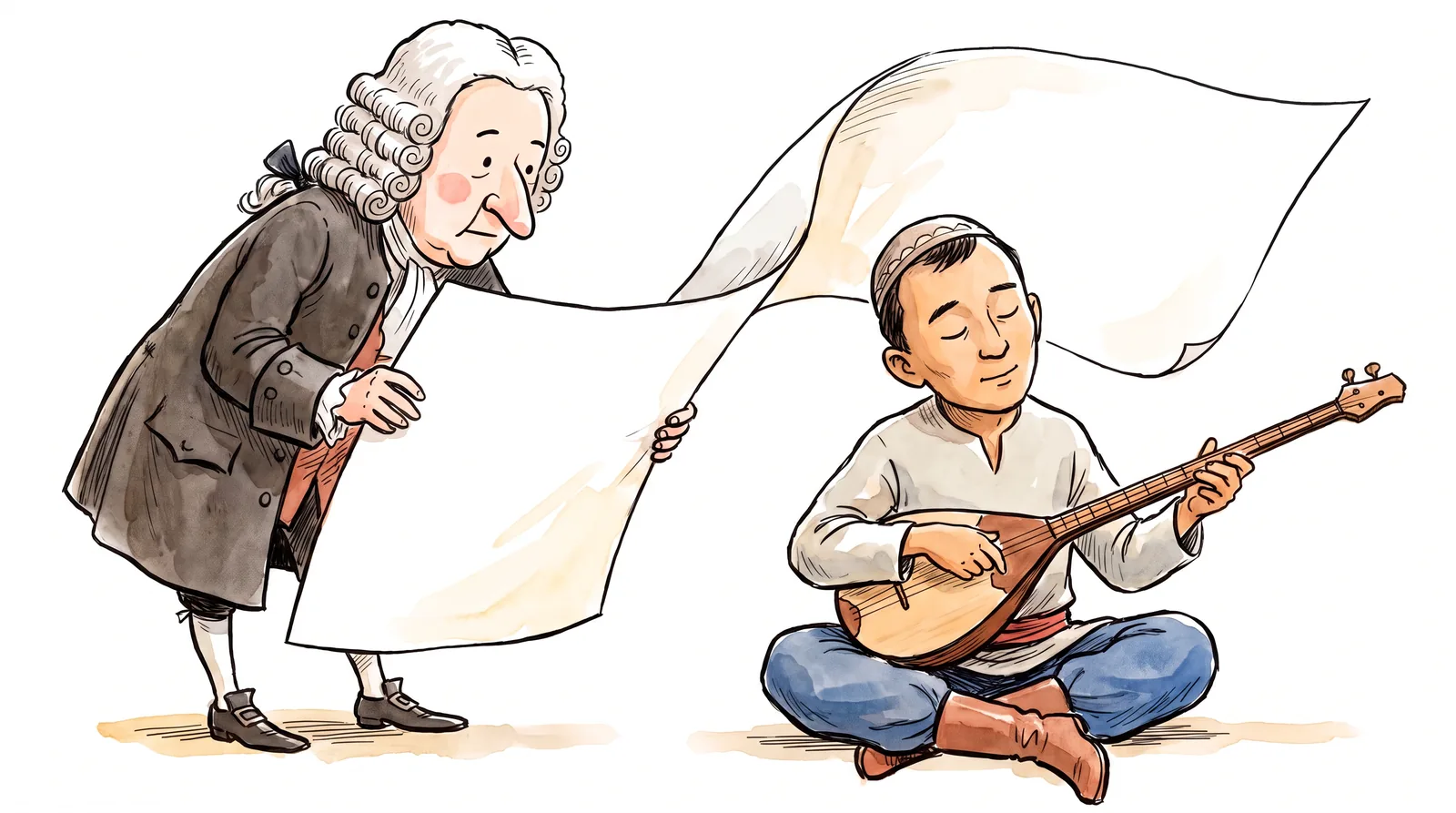
The dombyra is a two-stringed instrument, but two strings alone do not turn any piece into a “note against note” exercise. A kui owes no answer to the assignment Dana received.
Its rhythm, the melody’s motion, the sound combinations, the playing manner can be studied. Performance decisions can be compared and discussed with a musician who knows this tradition. Such a conversation needs grounds belonging to the music itself and the asked question.
Judging a kui only by whether it suits a strict-style teaching assignment teaches its fit for that assignment. That answer does not replace an artistic assessment of the kui.
The point is not that Fux’s rules are banned from the dombyra. A special exercise or arrangement can be composed for it, with counterpoint demands picked in advance. Then checking them is fitting. What matters is the work’s aim and conditions, not the instrument’s name.
Before staging such an exam, understand which skill is to be checked. Otherwise the mark will concern an assignment the musician never received.
Which conclusion we may draw
Dana returns to her score page.
“Good as a finished assignment,” she refines. “And the music can still be worked on.”
“Now it’s clear,” says Timur.
He needed no breach hunt to keep his impression. She needed no belittling of the done work to admit the check’s limits.
Grounds are needed not only where an answer comes by computation. They live in a musician’s judgment too, when he points at a particular phrase and explains what he hears in it. Such reasons can be discussed, even if they never bring all listeners to one estimate.
What matters is understanding which conclusion they support. Meeting a rule, a good solution to a musical task, and listening pleasure may coincide. But none of them guarantees the other two.
In the epilogue we return to the claim you wrote down in the prologue. Now more questions can be put to it — and what your answer stands on can be said more precisely.