
Part II. What exactly are you claiming? Chapter five.
One Word, Three Definitions

Contents of Grounds
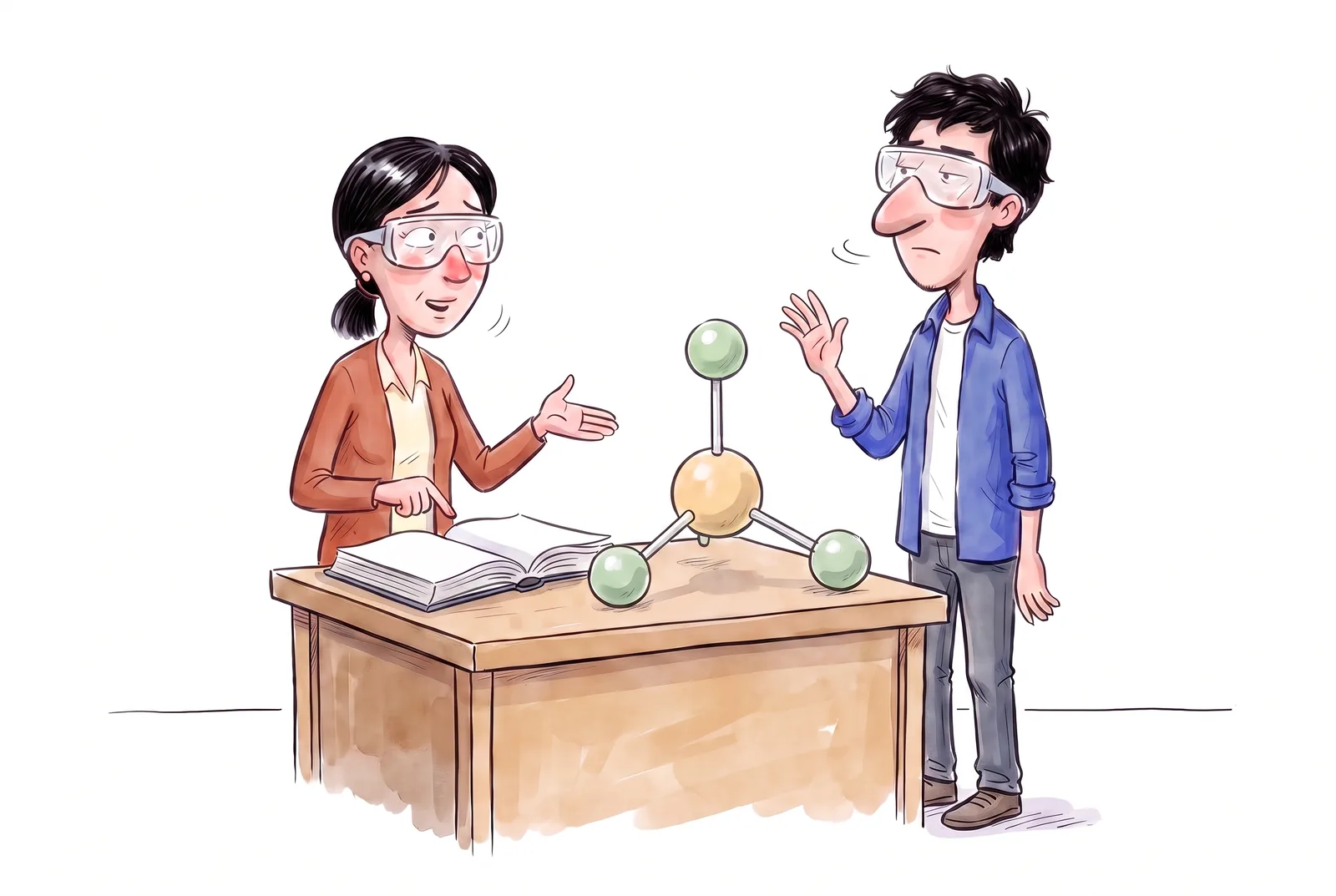
In chemistry class the teacher writes the formula BF₃ on the board — boron trifluoride.
“Is this an acid?”
“No,” says Timur. “There is not even hydrogen in the formula. What would it donate?”
“Yes,” says Dana. “The textbook gives it as an example.”
They share one textbook. The formula on the board is one too. Rechecking it is pointless: neither Timur nor Dana mixed up anything about the substance’s composition. But before deciding who is right, find out what each of them calls an acid.
Three questions under one word
Chemistry textbooks usually introduce three approaches to acids and bases. Each tells them apart by its own trait.
After Arrhenius, an acid in water solution forms hydrogen ions, and a base forms hydroxide ions. In water a hydrogen ion binds to a water molecule, forming the hydronium ion H₃O⁺. That refinement matters to a chemist; for us it suffices to notice that the definition describes a substance’s behaviour in water solution.
After Brønsted–Lowry, an acid donates a proton to another particle, and a base accepts one. The proton here is the H⁺ ion. Water is not required for such a reaction. But whatever the substance reacts with must be taken into account: water itself, say, may accept a proton in one reaction and donate one in another.
After Lewis, an acid accepts an electron pair to form a chemical bond, and a base supplies that pair. No hydrogen is needed for this.
These definitions arose from different chemical tasks. Arrhenius cared about water solutions. The Brønsted–Lowry approach allowed describing proton transfer beyond them. Lewis proposed looking at bond formation through a donated electron pair.
So behind a short “is this an acid?” there may stand different questions: what happens in water, who donates a proton, or who accepts an electron pair. Until we pin down the question, a “yes” risks meeting a “no” that belongs to a wholly different property.
What happens with BF₃
Start with Timur’s argument. The BF₃ molecule truly holds no hydrogen atoms, so it cannot donate an H⁺ ion. By Brønsted–Lowry this molecule is no acid. Here we can answer “no”: the composition is known and rules out exactly the possibility we ask about.
Now look at Dana’s example. The boron atom in BF₃ has its outer electron shell short of eight electrons. It can accept an electron pair to form one more bond. The nitrogen atom in the ammonia molecule NH₃ owns a lone pair — two electrons not yet engaged in bonding with another atom.
When BF₃ meets NH₃, that pair forms a bond between boron and nitrogen. Both electrons for it come from nitrogen, and in the formed bond the pair becomes shared. By Lewis’s definition boron trifluoride acts as the acid, ammonia as the base. Here too the “yes” has a perfectly definite ground: BF₃’s ability to accept an electron pair.
The molecule did not change from our opening another textbook chapter. We examined another of its properties.
And what of Arrhenius’s definition? It takes us back to water solution. The reaction with ammonia alone does not say how BF₃ behaves in water. That takes another process to consider.
BF₃ reacts with water, and other chemical particles appear in the solution. So no hydrogen in the starting formula does not yet mean the resulting medium cannot be acidic. Two claims must be kept apart: “the BF₃ molecule can donate a proton” and “BF₃ reacting with water makes an acidic medium”. We have taken the first apart already. The second needs information about the reaction with water and its products.
Lacking that information, we should say what exactly is missing. But it would be wrong to declare the substance’s behaviour unknown to chemistry only because we have not yet read the needed section.
May we pick a convenient definition
So far everything looks suspiciously handy. Want to say “acid” — pick Lewis. Want to say “not an acid” — cite Brønsted and Lowry. Does three definitions mean winning any argument?
Only by swapping the question mid-conversation.
Suppose we discuss the bond forming between BF₃ and NH₃. Lewis’s definition helps describe what both molecules do in this reaction. The remark “but BF₃ donates no proton” is true, yet it does nothing to explain this bond: no proton transfer is at issue here at all.
But if we ask whether the BF₃ molecule itself can be a proton source, its ability to accept an electron pair changes nothing in the answer. It still owns no hydrogen atom to pass on as H⁺.
A definition sets the trait to check. After that we need information about the substance and the reaction. Preference alone — ours, the teacher’s, or the textbook author’s — is not enough.
Of course, ambiguity may surface after the answer already sounded. Then it is fine to stop and say: “I meant something else. Let us pin it down.” Conversations often advance exactly like that. Trouble starts when a person quietly shifts a word’s meaning while pretending to have proved one and the same thing all along.
Nor do the three approaches split substances into three disjoint lists. They overlap widely, but they describe different sides of reactions. Arrhenius’s approach suits plain water solutions; Brønsted–Lowry suits proton transfer; Lewis suits the bond in our BF₃ and NH₃ example. The choice depends on what we want to understand.
What Timur and Dana argued about
Back to the board. The teacher asks both to manage without the word “acid”.
“BF₃ cannot donate a proton,” says Timur.
“But it can accept an electron pair to form a bond,” says Dana.
Now these claims can be seen to agree. Timur’s first “not an acid” was too broad, and Dana’s answer lacked a qualification. Once both named the property they meant, the reason to disagree was gone.
In the last chapter we had to pin down by which rule a heavenly body is called a planet. Here we had to ask which property hides behind a familiar chemical term. Sometimes that suffices to see: two answers do not contradict each other at all.
Pinning down, of course, settles no argument by itself. We may agree on every word’s meaning and still part over our estimate of the information — or find there is too little of it. But then at least it is clear what needs checking. While the question’s meaning shifts from speaker to speaker, even a right answer is easy to mistake for a wrong one.
In chemistry definitions have names. In everyday speech there are usually no such hints. In the next chapter we will try to work out what “speaking Kazakh correctly” means. There, one word will hide four different demands at once.