
Part One. The answer is not a verdict. Chapter four.
Who Gets to Decide What Is Reasonable?

Contents of Canons
…what an objective, reasonable person would have understood the commercial to convey. Leonard v. PepsiCo, Inc., 88 F. Supp. 2d 116 (S.D.N.Y. 1999)
The commercial ran in 1995. A teenager gets ready for school to a military drumroll: a Pepsi Stuff T-shirt, seventy-five points; a leather jacket; sunglasses. Then the wind rises, three boys gaze up, and a Harrier jump jet lands in front of the school. The boy climbs out, says “Sure beats the bus”, and the caption reads: HARRIER FIGHTER 7,000,000 PEPSI POINTS.
A twenty-one-year-old in Seattle read the caption as a price. The rules of the promotion let you buy points at ten cents each. He raised the money, sent in an order form with fifteen original points and a check for seven hundred thousand and eight dollars fifty, and asked for the jet. PepsiCo returned the check. He sued for the plane.
Does he get it? Nearly everyone says no, and nearly everyone gives the same reason: no reasonable person would think a soft-drink company was giving away a fighter aircraft. Hold on to that reason. The chapter is about who is allowed to give it.
Three reasons, not one
The case reached Judge Kimba Wood of the federal court in Manhattan, and in 1999 she dismissed it. Her opinion gives three reasons, each on its own enough to dismiss the claim. First, the commercial was merely an advertisement, not an offer. Second, its tongue-in-cheek attitude would not lead a reasonable person to conclude that the company was giving away jets. Third, there was no signed writing between the parties, and a contract for goods above five hundred dollars needs one. The opinion calls the third an entirely separate reason, and it is.
That opinion, not the commercial, is what was rewritten for the machine. The commercial, the catalogue and the order form are known to the model only as the opinion describes them, and the appeal that affirmed her the following year is not in it.
Now the experiment. Give the machine the facts as the opinion describes them, but hold back one thing: the judge’s finding about what a reasonable person would have understood. Everything else stays. Are there grounds to dismiss the claim? Established: yes. Beside the answer stand the rules that carried it, and there are two of them, not three: the advertisement was not an offer, and there is no writing. The second reason is missing.
The question the machine will not answer
It is missing because the second reason turns on a question the author of the model refused to let the machine decide. Ask it directly: would an objective, reasonable person have understood the commercial as an offer of the jet?
Not established. And the answer names what is missing: a finding whether a reasonable person would have taken the commercial as an offer of the jet, and who is entitled to make it, the court. That is not a message addressed to anyone. It is a line in the answer naming the conclusion the machine will not draw itself, and whose conclusion it needs instead.
You gave your own answer to that question a page ago, in a few seconds, and you were probably right. The machine does not say you were wrong. It says that “reasonable” is not a fact of the case and not a rule of the opinion; it is a finding someone with authority makes, and until that finding is handed to it the machine holds the question open and names them. That is the first choice of the author, and it follows the opinion’s own words: the test is what an objective, reasonable person would have understood, and the opinion says this is for the court, not a jury, because the words and actions here were so clear that reasonable people could not differ. The model carries that too: ask whether the question is for the court, and the answer is established.
Now give the machine Judge Wood’s finding: no reasonable person would have understood the commercial as an offer. Ask again whether the commercial was objectively understood as an offer. Still not established: the negative judicial finding closes the request for an external decision, but the model has no bridge deriving the negation of this queried proposition from that finding. Closing the request and deriving a negation are separate operations. Does the claim fail? Established, as before: the other two grounds were enough on their own.
Now suppose the opposite finding: a judge held that a reasonable person would have read the commercial as an offer. Enter that instead. The machine now records that a reasonable person would have understood the commercial as an offer: established. That is one condition of an offer, not the offer itself; the advertisement still fails the others. Does the claim still fail?
Yes. Established. The first and third reasons are untouched. That is what “three separate reasons” means when it is run rather than read: reversing the judge on reasonableness moves nothing, because the other two grounds each defeat the claim alone.
One limit of the model belongs here. The opinion lists five circumstances that made the commercial an evident joke, from the improbable pilot to a price of seven hundred thousand dollars for a machine that cost tens of millions, and never says how many of the five would have sufficed. The model requires all five; give it four and it says neither “in jest” nor “not in jest”. That silence is a choice, and a visible one: the rule has five conditions, and you can count them.
Taking the reasons away one at a time
If reversing the judge does not win the jet, what would? Take the reasons away and see.
Following the principle illustrated by Lefkowitz v. Great Minneapolis Surplus Store, Inc. (1957), rewrite the commercial as a definite offer, leaving no essential terms open for negotiation. In this counterfactual version, it expressly offers the Harrier jet and specifies how the offer may be accepted. The scenario is deliberately hypothetical: it isolates the remaining contractual requirements and does not reconstruct what PepsiCo actually offered. The model ranks an exception for such advertisements above the general rule that advertisements are not offers. Now the commercial is an offer: established. Keep the favourable finding on reasonableness. Two reasons gone. Does the claim fail?
Established. The third reason stands alone: no signed writing. The opinion calls this an entirely separate reason, and the machine shows what that means: an advertisement that is an offer, understood as one by a reasonable person, accepted by performance, still yields no enforceable contract for a seven-hundred-thousand-dollar aircraft without a signed document.
Add the document: a writing signed by the party charged, establishing the contractual relationship. Does the claim fail?
Not established. And beside the answer, for the first time, an obligation: the seller owes the claimant delivery of the item. In a world where all three reasons are cured, the jet is owed. That world never existed, and the machine does not pretend it did. The row exists for a different reason: without it, “the claim fails” would be indistinguishable from a rule that fails every claim.
| The case | Does the claim fail? |
|---|---|
| Facts as the court found them | established: no offer, no writing |
| Judge finds no reasonable person would see an offer | established |
| Judge finds a reasonable person would see an offer | established: no offer, no writing |
| Commercial rewritten as an offer; favourable judgment | established: no writing |
| Signed writing added | not established; a duty to deliver arises |
The original comparisons and certificate checks are recorded in the experimental notes. The two rewritten-advertisement scenarios were separately rerun with the Harrier for this revision; their inputs and outputs are retained there. Those supplemental runs must be distinguished from the original certificate checks.
The retained run records are in the experimental notes.
What is left to argue about
The title asked who decides what is reasonable. The opinion’s answer is: the court itself, without a jury, because here reasonable people could not differ. The machine’s answer is narrower and worth stating exactly: not the machine. It carries the court’s finding, in either direction, and shows what follows from it; it never produces the finding. That is the line the author drew, and you can see the line in the answer as a request with an authority’s name on it.
Two more things are yours to dispute. The five findings: the model requires all of them, and the four-finding case is left open; a lawyer might say three would do, and the model says only that the opinion did not say so. And the rewriting itself: the commercial, the catalogue and the order form are known here only through the judge’s description of them, and the appellate decision that affirmed her is not in the model at all. A reader who thinks the judge described the commercial unfairly is arguing with the opinion, not the machine, and the machine has made sure that is where the argument lands.
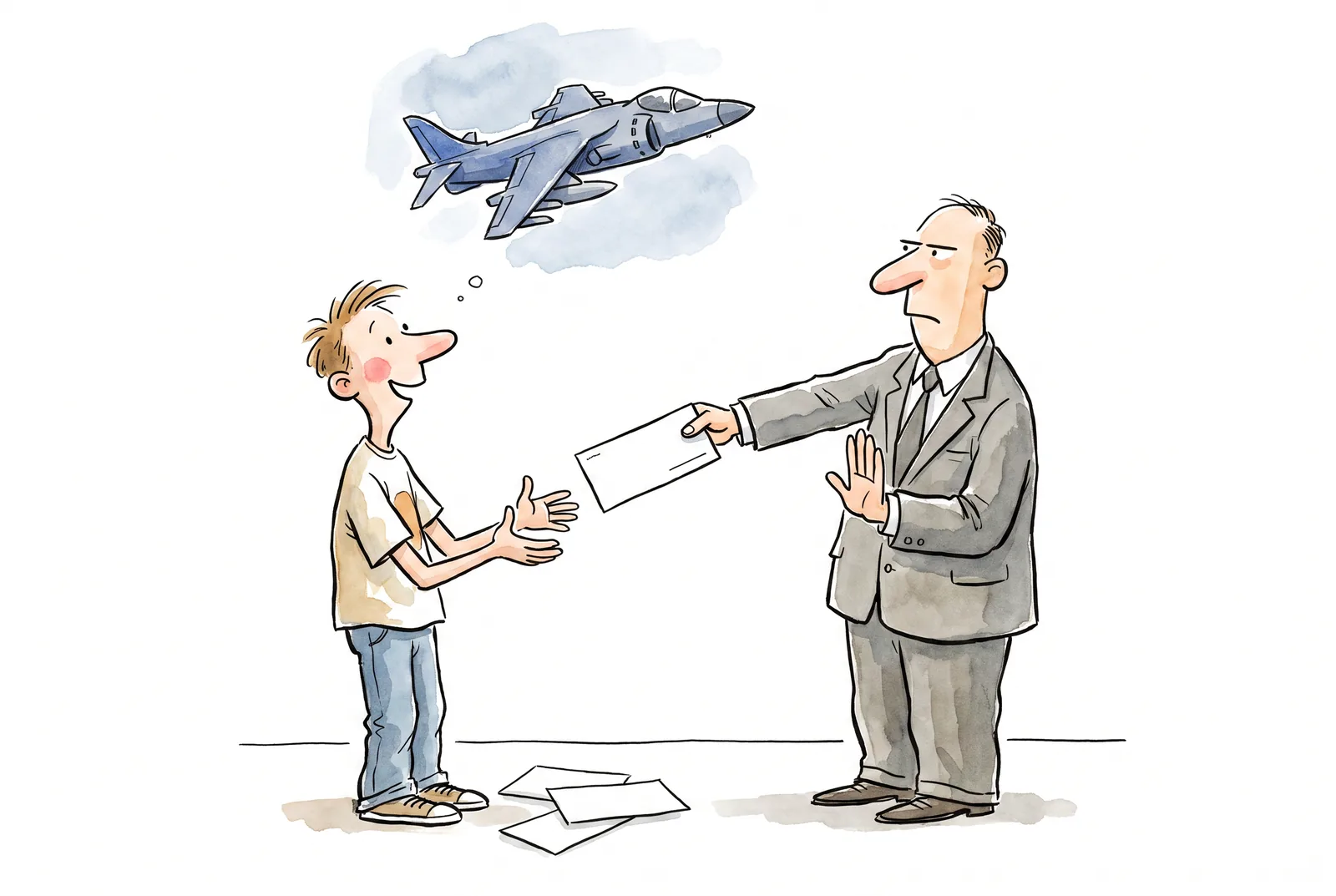
The boy in the commercial got the jet. The one in Seattle did not, and the machine can tell you that all three reasons would have to go before he could, which of them it can remove for you, and which one it is not its business to judge.