
Part Two. The model is not the source. Chapter ten.
A Counterexample Before an Amendment

Contents of Canons
“No, brother, you won’t fool me this time. Give me the roots, and take the tops yourself.” “Tops and Roots”, Afanasyev, No. 24 (translation)
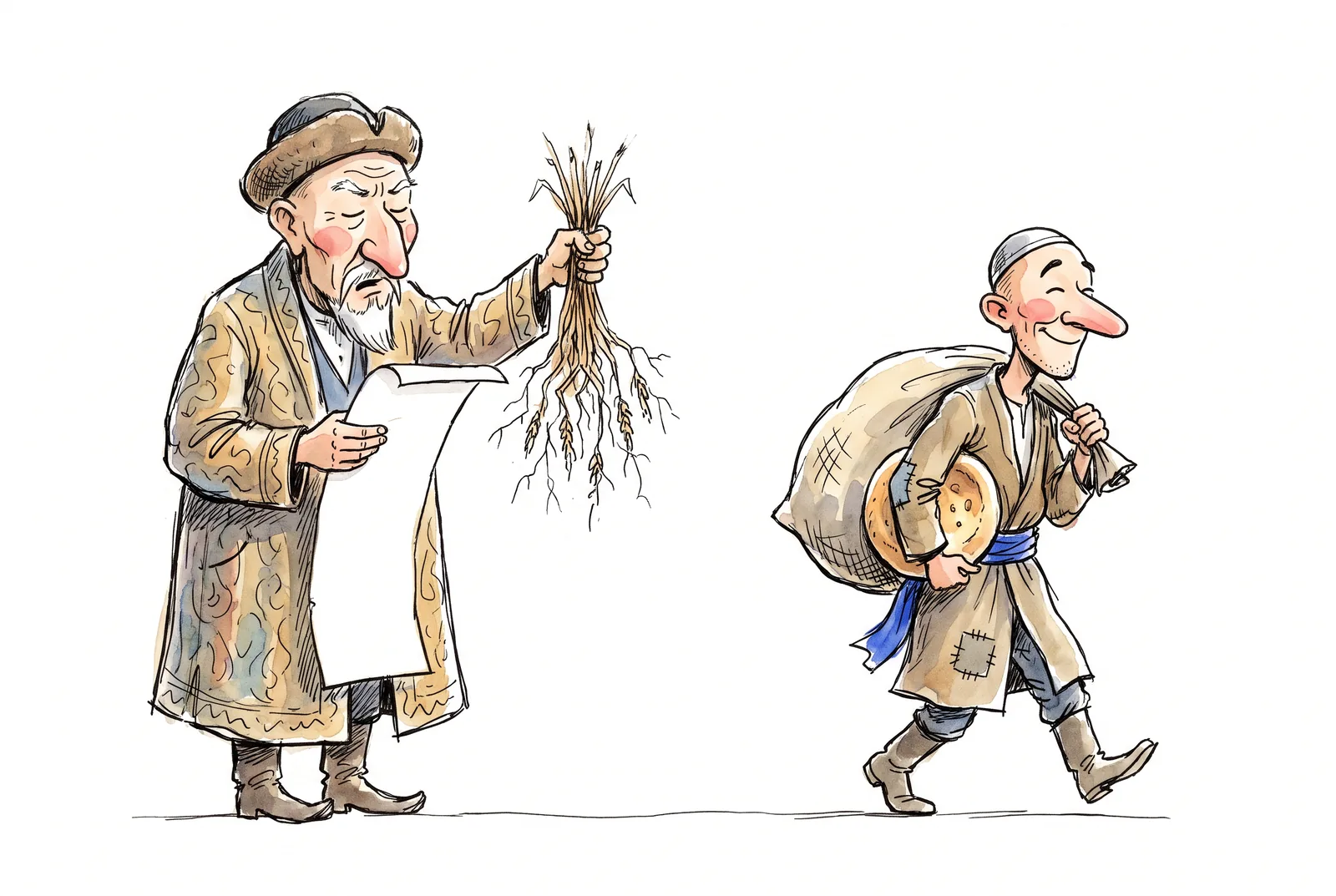
A peasant and a bear sow a field of turnips together. In the model used here, the peasant chooses what to plant: the bargain specifies how the harvest is divided and places no constraint on his choice of crop. When the crop is in, the peasant proposes the split: roots to me, tops to you. The bear agrees, takes a cartload of leaves, and discovers over dinner what a turnip is. He has been had, and he says so.
Next spring they sow again. The bear has learned. Before the sowing he states his terms: this time the roots are mine. The peasant agrees. Stop here. The peasant chooses what to sow. Which crop lets him leave the bear the worthless part again?
You probably have it. The field is wheat. The bear gets the roots of the wheat, which are worth nothing, and the peasant takes the grain.
The Grimms tell a version with a devil instead of a bear. What I want from you is not the moral but the drafting. Imagine that you have seen how the bear’s second bargain will end. You are now sent back to the spring before he signs it, as his lawyer. What should you advise him to change? Some say “the bear picks the crop”, others “split by value, not by part”. Hold your answer. This chapter is about what a machine can and cannot tell the bear before he signs.
The model treats the bargain, not the tale, as its subject. There is no court in the forest and no legislature; there is an agreement between two parties, in two editions, taken from the version of the tale in Afanasyev’s collection. Two conditions of the model should be said out loud. Only the turnip root and the wheat grain count as valuable; every other part is worthless. And the crop is chosen by whoever sows it, which the agreement does not constrain. Everything below is a run on that agreement, and the lesson about amendments would hold for a contract with real money in it.
Two editions, two crops, four runs
The model has two editions of the agreement. In the first, the bear is allotted the tops. In the second, after his amendment, the roots. Each edition has a season. The crop in each season is a fact the parties supply.
That gives four combinations, and the modeller ran all four, though the tale tells only two.
| Turnips | Wheat | |
|---|---|---|
| First edition: tops to the bear | worthless part to the bear (as in the tale) | valuable part to the bear |
| Second edition: roots to the bear | valuable part to the bear | worthless part to the bear (as in the tale) |
Read the square and the tale’s usual moral falls apart. It is not true that the bear loses whatever he does. Under each edition there is a crop that would have made him the winner. He lost both years because a second variable, which crop to sow, is bound by nothing in the agreement and stayed with the peasant. The amendment moved the variable the bear could see and left the one that decided.
Two of the four runs are counterfactual, and the machine does not mind. It has no notion of what happened; it has an edition, a season’s facts and a question. That indifference is the point. The bear could have asked the second-edition-turnip question before the second spring, and the answer would have told him that “roots to me” wins only if the peasant sows turnips again, which the peasant was never going to do.
Not a single breach
Now the part that makes the tale a loophole and not just a bad deal.
Ask the model about the duty in each historical year: did the peasant deliver to the bear the part the agreement allotted him? Both years, the answer is that the duty was satisfied. Not “not yet breached”. Satisfied. The tops were delivered in year one and the roots in year two, to the letter. Zero violated obligations, and the bear’s purpose defeated twice.
That combination is the machine’s working definition of a loophole: a path to a goal along which no obligation is ever violated. And the loophole lives in a rule the agreement does not contain, which is why no amount of reading the rules it does contain would have found it.
The bear’s response in the tale is not a lawsuit. It is “don’t come to my forest for firewood”. The model has that too, and the way it has it is instructive. Whether the bear was deceived is not derived from any fact; it is a judgment, and the authority who makes it is the aggrieved party himself. Ask whether deceit is established and the machine returns a request for judgment addressed to the bear. Supply the bear’s judgment and the sanction follows, with zero violated norms still on the record. The modeller’s note on this is one line: “the victim as his own judge is what self-help looks like when you write it down.” A legal order that lacks a court is not a gap in the model. It is a property of the forest.
Three tools, two honest failures
Three different questions can be put to the machine about change, and they should be kept apart before the answers arrive. First, compare the two editions of the agreement as they stand: what did the bear’s amendment actually change? Second, let the machine alter the rules on the bear’s behalf: is there a small amendment that would have won him the crop? Third, keep the rules fixed and search the peasant’s possible actions: is there a way for the peasant to reach the valuable part without breaking any rule? Note whose goal each one serves. The second looks for the bear’s win; the third looks for the peasant’s. I ran all three. One succeeded. Two failed, and both failures are the kind you want.
What the amendment changed. The machine compares the two editions across the four combinations and reports that the outcome changed in all four. That surprised me, because in two of the four the short answer, whether the bear gets the valuable part, was “not established” both before and after. What changed was not the short answer but the list of obligations in force. The duty to deliver the allotted part exists in exactly one edition for each year of the tale: in the first-edition turnip year it is there before the amendment and gone after, and in the second-edition wheat year the reverse. The amendment did not just move the harvest; it moved which obligations exist at all on a given set of facts. A comparison that looked only at the short answers would miss those changes. “Unchanged” means unchanged in the properties actually compared; the obligations in force must be among them.
The minimal amendment. Ask the machine for the smallest change to the agreement’s rules under which the bear gets the valuable part in the second-edition wheat year, keeping the other three combinations as they are. The answer is that no such change exists among the changes the search is allowed to make, and it tried all of them. This search cannot add conditions. It can only remove rules, reorder them, or drop a date. The amendment the bear needed was an addition: bind the crop to joint consent, or split by value, or name the crop in the deal. Among the changes allowed to it, the needed amendment was not there, and the machine says so by failing completely rather than by offering something plausible.
The loophole search. Ask the machine to find a sequence of actions that gets the peasant the valuable part in year two with no obligation violated. It did not find one, and it failed twice, for two reasons that are worth more than a success. The first time, the action that actually performs the division had been left out of the set of actions the search was allowed to try, and the machine said so: its verdict was not “not found” but “the search was cut short before it began”. The second time, with every action allowed, the sequences it tried were too short: the division in the tale takes several steps beyond what the search started from, and it searched two. A negative result from a search is a claim about the space that was searched, and this one now says exactly which space. The loophole itself is shown by the four squares, not by the search.
What the counterexample buys
The bear amended without a counterexample. He asked himself “what went wrong” and answered “I got the tops”, so he asked for the roots. The question he did not ask was “under my new terms, is there a crop where I still lose?” That question has a mechanical answer, and the answer was yes before the ink dried.
That is the chapter’s whole claim, and it is modest. A machine that holds the agreement as rules can be asked about the world you have not seen. Its amendment search cannot add conditions, and among the changes allowed to it the clause the bear needed was not there. Its loophole search did not find this loophole, first because the deciding action was left out of the search and then because the sequences it tried were too short. It cannot say whether anyone was deceived; it hands that to the bear. What it can do is run the four squares before the bear signs the second one, and one of those squares is the counterexample.
“Roots to me” was the right sentence in the wrong contract. The machine would not have written a better sentence. It would have shown the bear, a spring early, that the sentence he had written was not the one that mattered.