
Part Two. The model is not the source. Chapter nine.
One Case, Five Legal Traditions

Contents of Canons
En fait de meubles, la possession vaut titre. Code civil des Français, 1804, article 2279
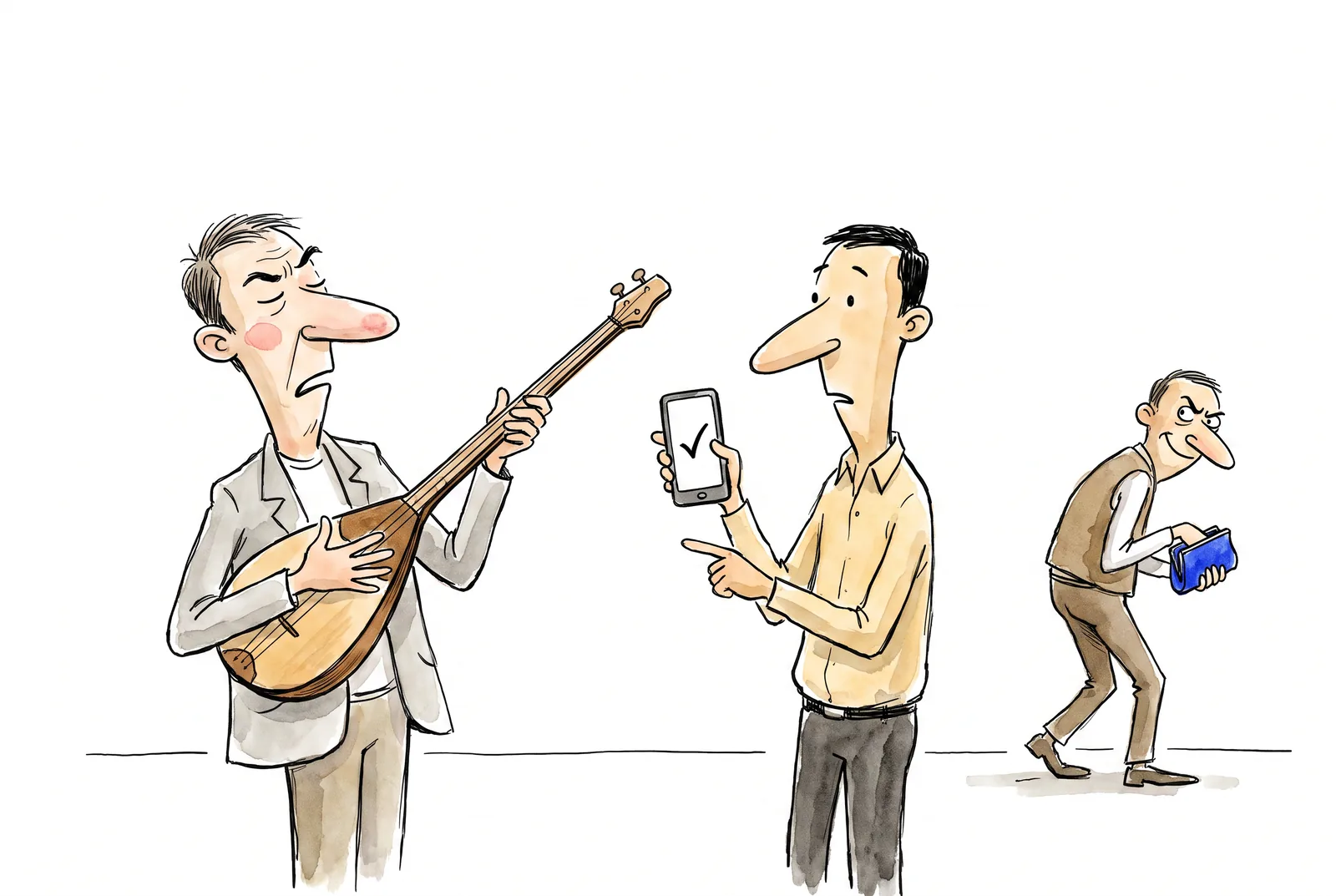
Picture this. Nurlan is going away and leaves his dombyra with an acquaintance for safekeeping. The acquaintance sells it to a man who knows nothing of the arrangement. Coming back, Nurlan finds the instrument and demands it back.
“This is my dombyra.”
“And I paid for it.”
The acquaintance, who could explain the situation to both, is staying silent for now.
Behind this invented exchange stands an old question: whose claim should win, when the owner never agreed to the sale and the buyer knew nothing of another’s deceit? Now the legal case, as we will compare it across sources.
Titius owns a thing. He leaves it with Seius for safekeeping. Seius sells it to Maevius, who pays the price and has no idea that Seius is not the owner. Titius finds out, finds Maevius, and demands the thing back.
Who keeps it?
Titius has a plain argument: he is the owner and never meant to sell. Maevius has his own: he is an honest buyer, he paid, and he should not answer for another’s deceit. One of them risks walking away with nothing, though both were deceived by Seius.
Try to pick a side before reading on.
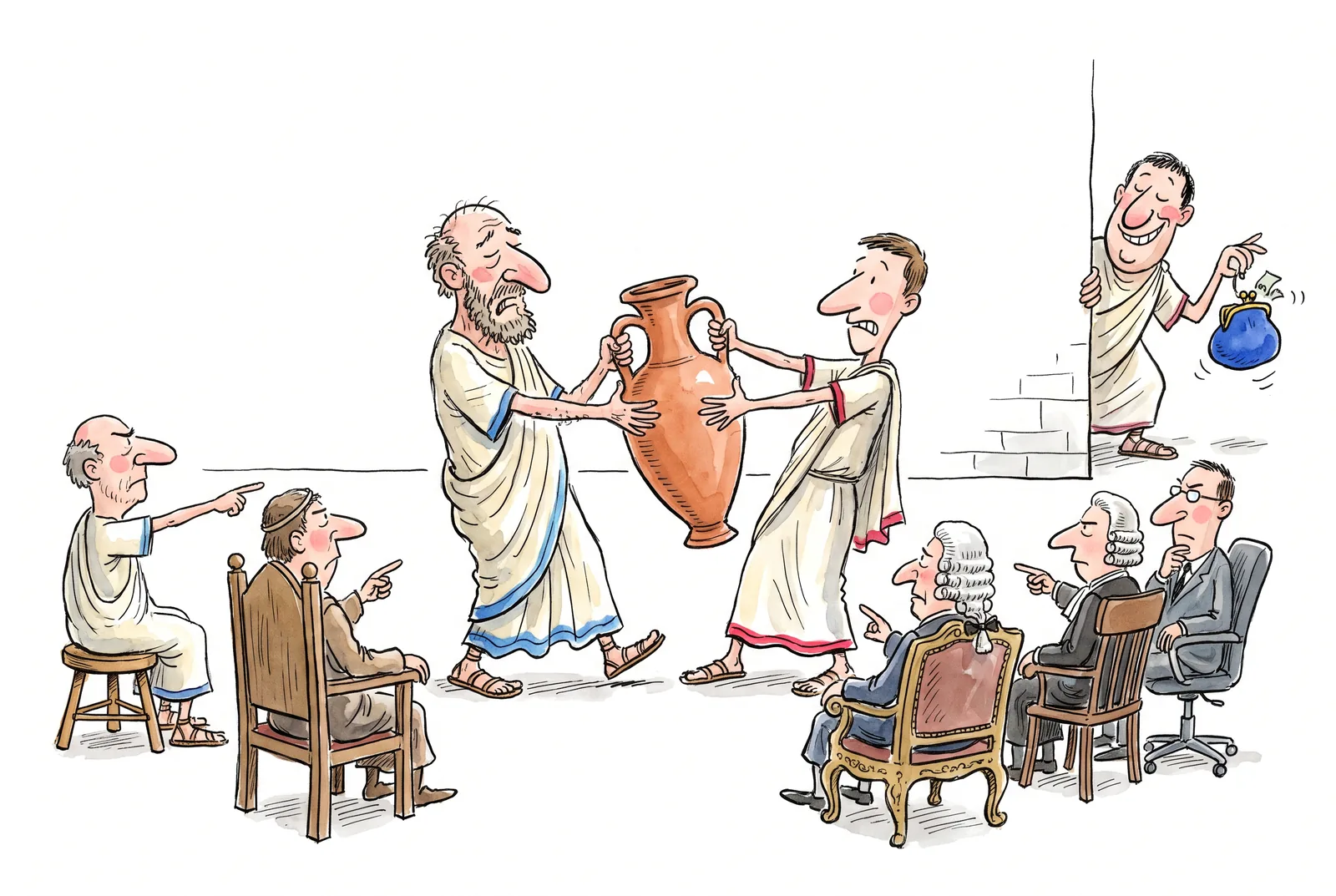
Both groups have the law on their side. That is the whole chapter. The same case, in the same words, was put to six bodies of law from five legal traditions, Rome counted twice at two dates four centuries apart, and they split three against three. The split is not old against new: the Ottoman code of the 1870s sides with Gaius, and the French code of 1804 sides against him.
The names are Roman because the case is. Titius, Seius and Maevius are the placeholder names of the Roman jurists, and the comparison keeps them because every one of the six bodies of law has a place for a case told in these terms.
The same words
An argument over “Almaty or Astana?” can run for hours. One talks about the weather, another about work, a third about the city where his friends live.
“Let us first agree what ‘better’ means.”
“You just ruined the argument.”
For comparing legal traditions this step is unavoidable: we must agree on the exact question we expect answered.
Here is what makes the comparison possible, and it was a choice.
Each legal order has its own word for the thing a person holds when the law will back them. The Roman jurist has an actio. The Ottoman Mejelle has a da’wa. The French code has an action, the German an Anspruch. The Russian-language version of Kazakhstan’s Civil Code uses isk (иск); Kazakh terminology uses talap (талап) and talap qoyu (талап қою), depending on context. These terms belong to different theories of what a claim or remedy means; putting their answers side by side requires an explicit comparison.
The model’s authors built one shared vocabulary and made every code speak into it. The vocabulary is Roman in shape: a right is called effective when the legal order gives a remedy and does not take it away, and every code is asked the same question, whether Titius’s right against Maevius is effective. The other outcomes the vocabulary knows will be explained when they appear.
These mappings serve this particular comparative question. They do not assert complete semantic equivalence between the legal traditions’ terms.
The vocabulary itself decides nothing. That is not a slogan; it is measured. Every case is also run against the vocabulary alone, with no code attached, and the expected answer there is always “not established”. If someone ever added a rule to the shared vocabulary that derived an answer from the bare facts, the vocabulary would have started judging by itself, and that empty run would turn colour. It has not.
Three yeses, three noes
Now the six answers to the case of the entrusted thing, in the order of their texts’ dates, which is not the order of their answers, each with the sentence it rests on.
Gaius, writing around the year 161. The owner may demand the thing back from whoever holds it. Good faith in the buyer is not something book four of his Institutes knows as a defence, and a possession of zero years cannot ripen into ownership. Titius wins.
Justinian, 533. Delivery transfers ownership when it comes from the owner; “a thing delivered by its owner is alienated”, and Seius was not the owner. Nothing has been held long enough to matter. Titius wins.
The Mejelle, the Ottoman civil code of 1869 to 1876, read as of 1900. A sale of what belongs to another is suspended until the owner approves it. Without that approval the buyer holds another’s property without lawful cause and must return it. The buyer’s honesty is not a category the code uses here. Titius wins.
The Code civil of 1804, read as of 1810. “In the matter of movables, possession is as good as title.” The honest possessor who got the thing from a non-owner is protected, and the owner may reclaim it only if it was lost or stolen, and then for three years. Titius handed it over himself. Maevius keeps it.
The German civil code of 1896, in force from 1900. The acquirer becomes owner even if the thing was not the seller’s, unless he was in bad faith at the time, and unless the thing had gone astray from the owner: lost, stolen, or otherwise out of his hands against his will. Entrusted is not against his will. Maevius keeps it.
The Civil Code of Kazakhstan, read on the second of September 2026. The owner may reclaim from a buyer who paid and did not know of the owner’s right only when the property was lost, stolen, or left the owner’s possession against his will. It left with Titius’s consent. Maevius keeps it.
Look at what the three modern noes have in common. Not good faith on its own. The hinge in each is whether Titius parted with the thing willingly. Change one fact, make Seius a thief instead of a custodian, and the model’s fifth case gives the answer: all six bodies of law hand the thing back to Titius, the French and the Kazakh included. Eighteen centuries agree about theft. What they disagree about is a much narrower thing: who bears the loss when an owner chooses badly whom to trust.
That sentence is not the machine’s. The machine produced six cells and six article numbers. The pattern across them is mine, and a reader who sees a different one has the same cells to argue from.
Two kinds of no
Time is the second thing the registry varies, and here the vocabulary earned its keep in a way I did not expect. What follows is a separate case, not a continuation of the entrusted thing; its facts are set afresh.
Maevius has held a movable thing honestly, on a lawful basis, for one full year, and only then does the former owner, Titius again, come for it. Under Gaius a year of possession of a movable makes the possessor owner; the Twelve Tables said so. Under Justinian it takes three years. Under the German code ten, under the Kazakh five. The Mejelle has no such thing as ownership by lapse of time at all; what it has is a rule that a claim is not heard after fifteen years. And the French code needs no year, because possession was title from the first day.
So after one year, under Justinian, the German code, the Mejelle and the Kazakh code, Titius can still demand the thing back; under the French code he cannot. In Rome under Gaius the machine says something else: not established.
Not “refuted”, and the difference is the point, though it takes a sentence to state without the vocabulary. The model derives no claim for the former owner, because by its rules ownership has already passed to the possessor. That is a different situation from the one in which the owner keeps his ownership but cannot obtain the return. To the person asking “do I get it back?” both are a no; the grounds differ. The vocabulary keeps them apart by a choice of its authors: “refuted” is reserved for a remedy that was given and then taken away, and the absence of any claim is recorded as “not established”. A convention to know: the same word also appears when facts are simply missing, so the cell’s note, not the word alone, tells you which it is.
Another separate case: land, held for thirty years. Now Gaius, Justinian, the French and the Kazakh codes all say the same “not established”: the land has changed hands by the passage of time and the old owner has no claim. The Mejelle and the German code say “refuted”, and mean the other thing by it. The old owner is still the owner. His right is intact. But the claim has become one the court will not hear, or one the possessor may refuse to satisfy. A right with no remedy; the vocabulary calls it naked.
Whether that distinction matters depends on what happens next. The model has a case for that too. If the debtor pays a debt whose time has run, can he get the money back? Every modern code in the chain says no, each in its own article: what was paid on a naked right stays paid. The right was real; only the remedy was gone. A reader who thought “prescribed” meant “extinguished” has learned, from a table, that four legal orders disagree with him and say so in writing.
How the table was made honest
A table like this is easy to fake. You decide what each code should say, then adjust the model until it says it. The methodological rule against that is simple and was followed: the expected answer in every cell was written from the code’s text, with the article it rests on, before the run. A cell that comes out wrong is a subject for analysis, not a reason to change the expectation.
A possession rule needs the conditions under which possession counts as title. A model that records the protection but omits the qualifying purchase can give a different answer from the source. The expected answer should stay tied to the code while the missing condition is examined. Otherwise a table can appear consistent simply because its expectations were adjusted to match it.
The machine answers from the model. Keeping the source, the chosen reading and the expectation distinct makes the table open to scrutiny.
Two more things the table keeps in view rather than hiding: some cells are marked skipped, with a reason, rather than answered, and the published table carries the date of the models it was made from. The experimental notes have both.
What the machine did not do
It did not compare. It ran six models on one set of facts and wrote six records. Nothing in the machine knows that the six are related; the table is a reader’s arrangement of six independent answers, each with its own proof.
It did not read the codes whole. Each model covers eight blocks chosen by the modeller: persons, things, possession, ownership, obligations, delicts, intestate succession, remedies. The Code civil has over two thousand articles and the model carries a few dozen. That is declared, block by block, as a boundary, and the boundary is part of the record.
It did not read the current French or German law. The models are the first editions, 1804 and 1896, because the chain was built as history, and that was a choice with a name on it. Anyone who wants the modern articles has to build them as later editions of the same acts, and the machine will then show what changed and when.
It did not translate the Mejelle from the Arabic or the Institutes from the Latin for you. Every model is built from the pinned original text, and the notes in the cells are the modeller’s reading of it, marked as such.
Where would you rather be Titius
Back to the thing on the table.
Where would you rather be Titius? Under Gaius, or under any Ottoman judge applying the Mejelle. Where would you rather be Maevius? Under the Napoleonic code, where possession was title before he had finished counting out the price.
The machine says nothing about which is right. It says: here are six answers, each with its article; here is the one fact that flips three of them, whether Titius handed the thing over himself; and here is what none of the six will say, because none of the six models contains it: a reason. The reason is in the history of trade, in the eighteenth century’s need for goods to change hands without a title search, and it lives in books the machine has not read. What changed in 1804 was not who counts as honest. It was whose carelessness the law decided to charge. The table shows the change. The reason belongs to a history book, and this chapter was never going to be one.