
Part One. The answer is not a verdict. Chapter five.
A Right You Must Exercise

Contents of Canons
The game is drawn, upon a correct claim by a player having the move, when the same position for at least the third time… FIDE Laws of Chess, Article 9.2
Imagine a game. The same position has just appeared on the board for the third time, and it is White’s move. Nobody has claimed a draw. Both players know the club rule: threefold repetition is a draw.
For repetition purposes, positions are identical only when the same player has the move, pieces of the same kind and colour occupy the same squares, and the possible moves are the same. Castling rights and en passant can matter. The model receives that determination from the game record rather than calculating it.
Is the repetition itself enough to end the game? Take a moment. Most people say yes.
Ask the machine, which has the 2023 Laws of Chess in a form it can run, and it says: not established.
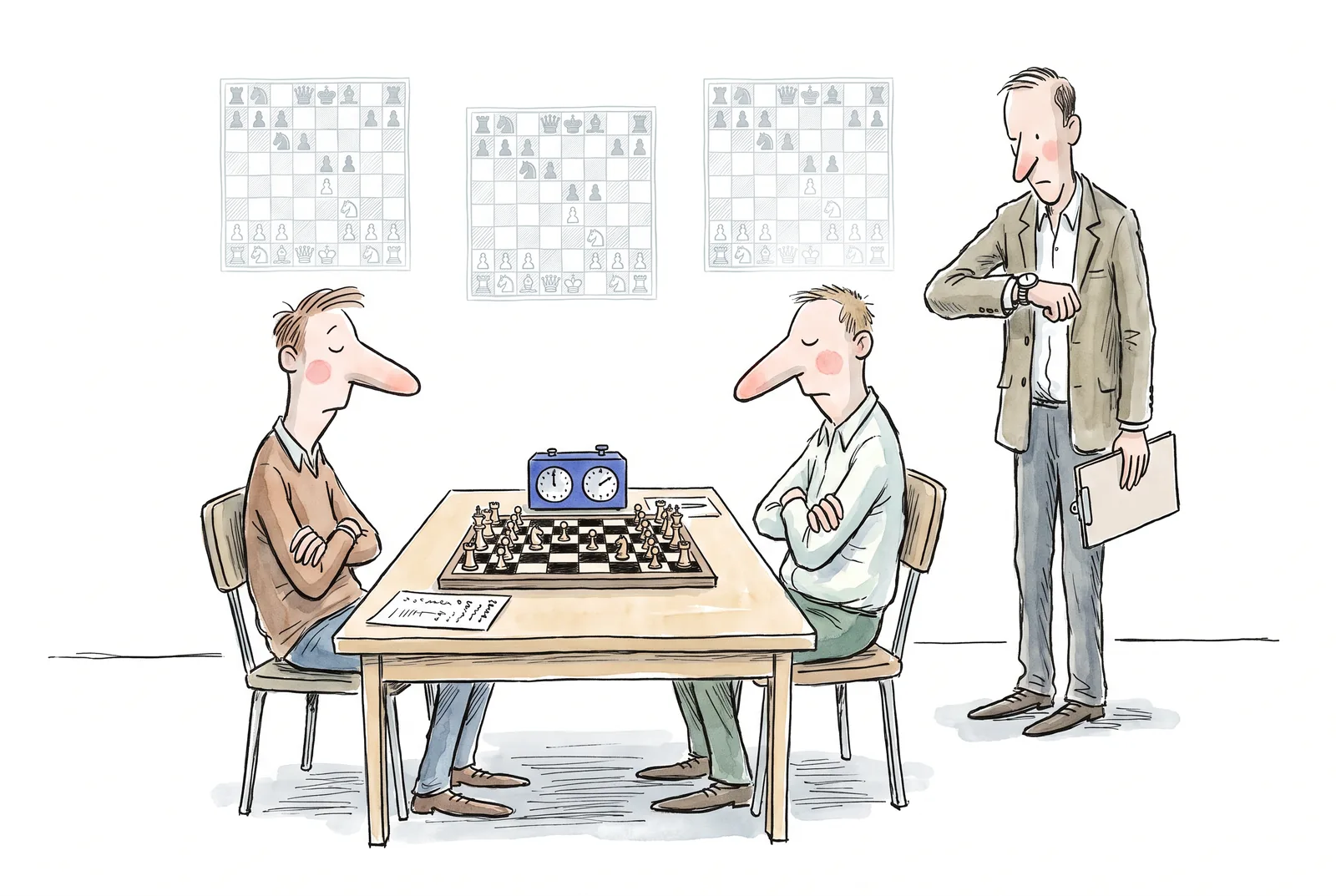
Not because it disagrees with you about the position. Because the rule does not say what most people remember it saying. Read the epigraph again: the game is drawn upon a correct claim by a player having the move. The draw does not happen to the board. White has acquired a right, the right to claim the draw. Until White claims it, the repetition ends nothing, and playing on is no breach of anything. Only the player with the move holds that right, and only now.
Who may claim, and when
Let White claim. Drawn: established. The answer names both steps: the claim is correct, and a correct claim ends the game at once.
Now suppose Black claims and White says nothing. Drawn?
Not established. Black does not have the move, so Black holds no such right at this moment. Black’s claim produces no draw: in this model nothing is triggered by it, and the machine does not even mark it as refused. What other consequences the claim may have, the answer does not say. The claim does not establish a draw under the modelled repetition rule. Whether the game ends for another reason is a separate question.
Try one more. White claims, but the position has appeared only twice. Not established: the claim is incorrect and produces no draw. From that answer you cannot conclude that the claim has no consequences at all; the model says only that it does not end the game.
So the draw by repetition is a right in a precise sense. The condition, three occurrences, is a fact of the game. The draw is not. Between the fact and the draw stands an act that a particular person must perform at a particular moment, and a machine that reads the rule as written must refuse to supply the act on the player’s behalf. Most players, and most summaries of the rules, quietly supply it. This one does not.
Here the model has to stop and say what it is. It is not a chess engine. It does not know where the pieces stand; it does not count repetitions or moves; it does not decide whether a move is legal or whether a king can still be mated. All of that arrives as facts of the record: who has the move, how many times the position has appeared, how many moves without a pawn move or capture, how many illegal moves each player has completed, whether the position is one in which mate is still possible. The person who wrote the model chose to take the count from the arbiter’s record rather than derive it from the moves, and the choice is not cosmetic: a model that counted for itself would draw its facts from another source, and the author chose the record.
A draw that needs no claim
Raise the count. The same position for the fifth time, and nobody says a word. Drawn?
Established. No claim, no player named. The Laws have a second rule, added in 2014, under which five occurrences end the game by themselves, and the machine applies it without asking who had the move. Three occurrences give a player a right; five take the decision away from both players.
| The record | Drawn? |
|---|---|
| Third occurrence; no claim | not established |
| Third occurrence; White, having the move, claims | established |
| Third occurrence; Black, not having the move, claims | not established |
| Second occurrence; White claims | not established |
| Fifth occurrence; no claim | established |
The Laws hold a second pair of the same kind, the fifty-move and seventy-five-move rules; both are in the experimental notes, and they change nothing in the picture.
Things that happen to you
Not every consequence in the Laws waits for a claim. Some fall on a player whether anyone asks or not.
A player completes an illegal move. Under the FIDE Laws, the first completed illegal move results in two additional minutes being awarded to the opponent. The model does not calculate clock adjustments; it addresses the consequences for the game’s result, and this first move does not establish a loss. The same player completes a second illegal move. Lost: established, and the game ended at that moment. Now change one fact: the opponent has nothing left to mate with. Lost?
Not established. Drawn: established. The article that declares the loss adds “however, the game is drawn if the position is such that the opponent cannot checkmate”, and the model reads both halves. What it takes as a fact, again, is the mate-possibility itself; that is analysis, not rule, and it comes from the record.
Notice one more choice hidden in that article. It says the arbiter “shall declare the game lost”. The model does not wait for the declaration; it treats the loss as following from the count, and the arbiter’s declaration as the announcement of a result already settled. That is a reading. A different author might have made the declaration itself the event, as the claim is for a draw, and then a second illegal move with no arbiter at hand would leave the game undecided. The model does not, and you may think it should.
So the chapter’s rules come in two kinds, and the machine treats the two kinds differently. Some consequences follow from the record by themselves: five repetitions, a second illegal move. Some follow only from an act that a named person must perform at a named moment: the claim of a draw. A player who knows only the first kind loses draws they were entitled to. A machine that modelled only the first kind would hand out draws nobody claimed. The third kind, findings that only an authority can make, was the fourth chapter’s subject; the Laws have their own, the arbiter’s judgment whether a piece was touched with intent, and it is in the experimental notes.
Every row above, and the rest of the model’s cases, were computed by two programs written independently of each other, and their answers agreed to the byte. A third program checked the derivations, and proves less here than in earlier chapters, because most of these rules compare counts; the experimental notes says what it vouched for.
What is left to argue about
The Laws of Chess are an unusually candid source: they say in their own preface that they cannot cover every case and that an arbiter’s judgment fills the gaps. The model takes them at their word, and that is where the disputes begin.
You may dispute the boundary of the record. The model asks the record for repetition counts and mate-possibility because deriving them would make it a chess engine and a different thing; a player who believes the arbiter’s count is wrong is arguing with the record, and the machine has made sure the argument lands there and not on the rule.
You may dispute the declaration. The loss for a second illegal move is automatic in the model and pronounced by the arbiter in the text; if you think the pronouncement is the event, the row for the second illegal move should read “not established until declared”, and the author chose otherwise.
And you may dispute what the model leaves out. A claim made before the move is played, by writing the move down and declaring the intention to make it, is a second form of the threefold claim in the Laws; the model knows only the claim on a position that has just appeared. Clocks, and with them the first illegal move’s penalty, are outside the articles it covers.
None of this is a verdict on any game. What the chapter shows is narrower: that a right can exist on paper, have its condition satisfied on the board, and still do nothing, because nobody with the power to exercise it did so in time, and that a machine which reads the rule honestly will tell you that rather than the draw you expected.