
Part Two. The model is not the source. Chapter seven.
Who Chose This Reading?

Contents of Canons
…reimbursement within seven days, by the means provided for in Article 7(3), of the full cost of the ticket… Regulation (EC) No 261/2004, Article 8(1)(a)
Back to the cancelled flight of the second chapter. The passenger chose a refund rather than re-routing on the first of August. The carrier paid on the eighth. The regulation says reimbursement is due within seven days.
Was the carrier in time? Count it out before reading on. Seven days from the first is the eighth, so most people say yes, and a few say the seven days ran from the cancellation, which was earlier, so no.
The machine says: not established. Not because it counted differently. Because it did not count at all. In the answer’s own record of what it applied there is a line for readings, and the line is empty.
Seven days from what
The regulation does not say when the seven days begin. From the cancellation? From the passenger’s claim? From the moment the passenger chose reimbursement over re-routing? The text is silent, and at least three starting points can be argued for.
The person who wrote the model did not pick one silently. The rule that counts the seven days from the passenger’s choice exists in the model, but it is wrapped in a declaration the model calls an interpretation, marked disputed, with a label that says, in the machine’s own words: the seven-day period has no starting point in the text; it may run from the cancellation, from the claim or from the choice; this formalisation reads it from the choice, because before the choice no duty to reimburse has arisen. The rule is written, but it applies only when that reading is selected. Without the selection the machine does not check the deadline at all.
Select it. Paid on the eighth: established, within seven days. Paid on the ninth: not established; with this reading in force, a payment on the ninth does not establish that the deadline was met. Deselect it: on either date the deadline is simply not checked. The right to reimbursement itself stands in every one of these answers; only the deadline question moves. And in every answer the record of applied readings names the reading in force, or names none.
So a reading can be in three states. Selected: its assumption is in force for this calculation. Not selected: its rule is not applied, and no other reading is chosen in its place; the question stays open. And baked in: the assumption is always in force, and the only way to change it is to change the model.
Compare the first chapter. There the two speeches were readings of the same kind, switched on and off to produce four answers. But the repair that made the table symmetrical, the condition that the victory must come from an earlier suit, was not written as a switchable reading. It was written into the base, as if it were the text. It was a reading too, and the first chapter said so. The difference between the two is not in the text. It is a decision of the author about which of their readings to expose as switches and which to bake in, and that decision is the first thing in this chapter you may dispute. Every baked-in reading is a switch the author decided you did not need.
The words the machine uses
There is a second layer of authorship between the text and the answer, and it is easier to miss because it looks like mere translation.
Every rule in a model carries the words it will be described with. When the machine says “the passenger has the right to compensation”, that sentence is not generated; it was written by the author as the rule’s label, in one or more languages, and the machine’s explanations are built from those labels. Read an answer and you are reading the author’s paraphrase of the law, one rule at a time.
Imagine it the other way round: you asked one short question and were sent three pages of explanation. You read them once, then again.
— Түсінбедім. I didn’t understand.
The explanation has been presented. But the reader still cannot say why this answer came out, or what exactly to argue with. The program’s explanations use wordings prepared by people. They name concepts, describe the conditions of rules and explain why an exception applies. Those words may render the calculation exactly and the meaning of the source badly, so an explanation needs its own examination. The author of a rule, the author of its wording and the translator may be different people; a correct calculation certifies none of their sentences.
Kazakhstan’s 2026 Constitution, adopted on 15 March 2026 and in force from 1 July 2026 in the pinned source edition, shows how far this goes. Article 14(1) provides that a citizen may not be extradited to a foreign state unless an international treaty provides otherwise. Its rules carry labels in Russian and Kazakh, the two authentic texts, and further languages are added from outside as translations, each marked as a working rendering by the formaliser and not an official text. Here is one rule, Article 14, paragraph 1, in the authentic Russian and in the English rendering:
Статья 14 пункт 1. Гражданин Республики Казахстан не может быть выдан иностранному государству
Article 14, paragraph 1. A citizen of the Republic of Kazakhstan may not be extradited to a foreign state
These are labels of one rule, not the full text of the article. In the pinned Russian source the ban is followed by a proviso: unless otherwise provided by international treaties of the Republic of Kazakhstan. The model expresses that proviso as a separate rule with priority. Read the first label alone and you can mistake a general rule for an unconditional ban and miss the exception.
So what needs checking is not only the translation against the Russian label, but the explanation as a whole — against the source and the shape of the model. A translation may render the label faithfully while the label, without its neighbouring rule, gives a false impression.
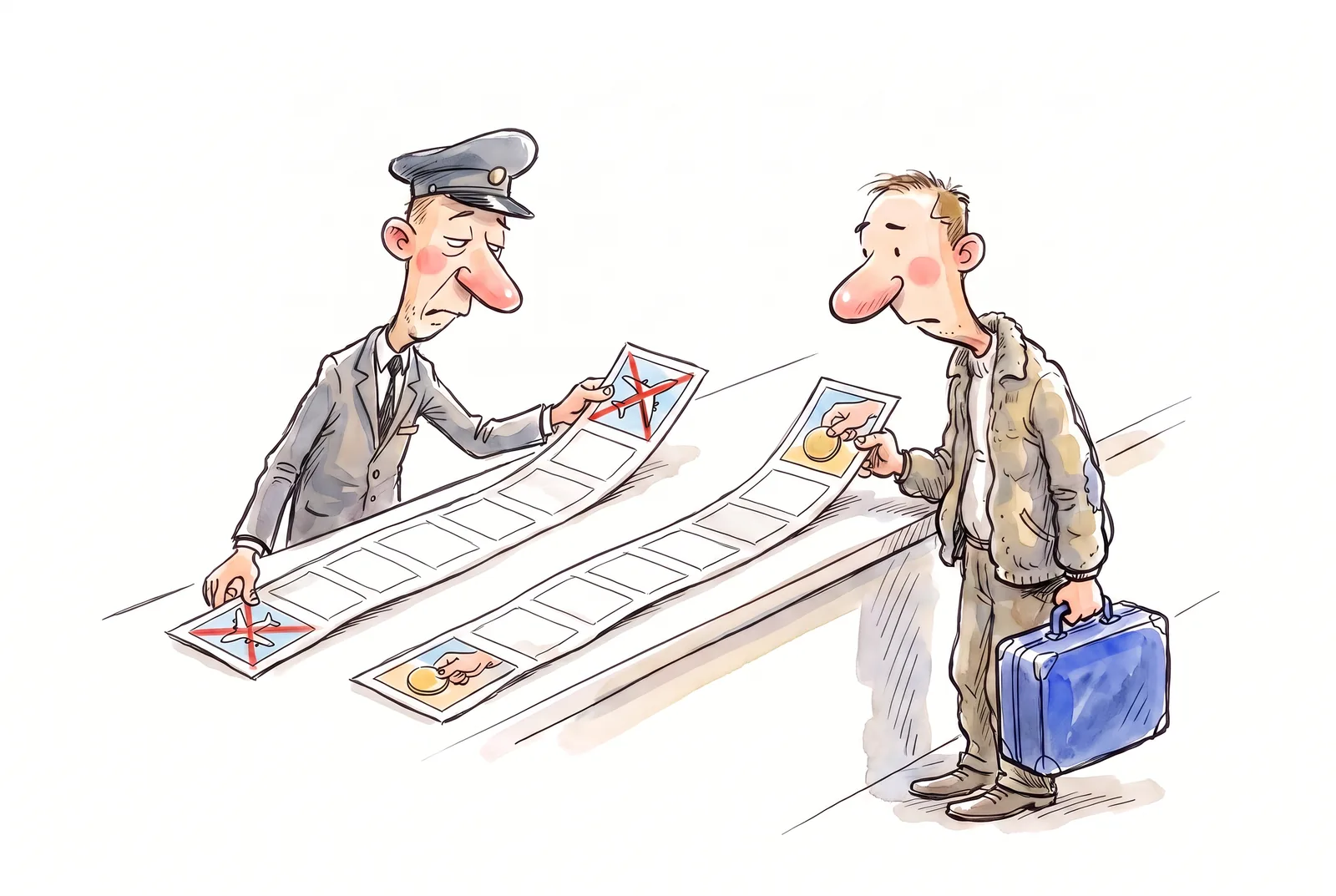
Selecting a reading changes the calculation. Selecting a language changes only the words of the explanation, and cannot change an answer, because the translations are kept out of the part of the model that computes. But an unchanged calculation does not prove that those words render the law faithfully. If the English is wrong, the rule is not wrong, the label is, and the current checker does not establish whether a rule’s natural-language label faithfully represents the source text. A translation makes the model checkable by more people. It certifies nothing.
How to object
Suppose you have read the label, switched the readings, looked at the articles, and you still think the author got it wrong. What then?
The first thing to notice is that the model has already told you what kind of wrong. A wrong reading is a switch you can flip or a baked-in condition you can point to. A wrong label is a sentence you can quote against the text. A missing rule is a measured gap of the kind the sixth chapter described. Each has an address, and an objection without an address is an opinion.
The public server carries a tool for exactly this. A report names the model and the rule or article, says what you expected and what you observed, and is written to a journal together with the fingerprint of the model it concerns, so that whoever reads it a week later knows which version was being argued with. What the report does not do is change anything. Nothing in the model moves because a report was filed; “not established” does not become “established” because someone objected. A person reads the journal.
That person has two ways to close a report. Either a rule is wrong and gets fixed, with a test behind the fix. Or the rules are right and the documentation was silent, and a note is added beside the rule so that the next reader with the same objection finds the answer already there. Take the objection this chapter has been circling: that the seven days should run from the claim, not from the choice. Filed, it would land with the person who keeps this model, and that person would have to decide, in writing, whether the choice is a reading to keep as a switch, to replace, or to bake in. The machine cannot make that decision. It can only make sure the objection arrives with an address.
There is a third channel, and it runs the other way. A lawyer can mark one rule’s wording, in one language, as checked against the text. That mark is a necessary condition for calling a fragment verified and not a sufficient one, and it lapses when the rule’s meaning or its wording changes. Who may dispute such a mark, and what happens to “verified” when they do, is a question the project has written down as open.
The retained run records are in the experimental notes.
What is left to argue about
Three things, and this time all three are the author’s.
The line between readings exposed as switches and readings baked into the base. The seven-day start is a switch; the earlier-suit condition of the first chapter is not; nothing in either text draws that line, and the answer shows only the switches.
The words. Every explanation the machine gives is a paraphrase written by a person, and in most of the Constitution’s languages the paraphrase is a working translation that nobody has approved. An unchanged calculation tells you the program did not change when the language did. It does not tell you the translation is faithful.
The institution. A channel for objections exists, keeps its records, and changes nothing by itself; a person decides, and the project’s own record says that how often reports are confirmed is not yet measured and that the mechanics of disputing a lawyer’s mark are not yet built. The machine can make the switchable choices of its author visible; the baked-in ones it shows only to a reader who knows where to look. It cannot make the author answer. The current checker does not establish whether a rule’s natural-language label faithfully represents the source text. That work is yours, and the model has been arranged so that you can do it.