
Part One. The answer is not a verdict. Chapter one.
Four Answers to One Case

Contents of Canons
…et utrimque pariter valet. Aulus Gellius, Attic Nights, V.10.3
You took a side in the prologue. This chapter is about what happens to it.
The story comes from Aulus Gellius, a Roman of the second century who collected curiosities into a book called Attic Nights. He does not tell it as a lawsuit. His chapter is about a kind of argument the Greeks called reversible: one that can be turned against the person who made it, and, in his words, “stands equally strong on both sides”. Protagoras against his pupil Euathlus is his stock example. Sixteen short paragraphs, no date, no sum, no city, no law: the judges are nameless, and Gellius says only that they thought the matter doubtful and put it off to a very distant day.
In August 2026, a modeller translated Gellius’s sixteen paragraphs into a set of executable rules and facts. That person made choices, and the chapter will come back to them, because they are where your side of the argument either survives or does not. Two of them matter from the start. The contract, the suit and the judges became rules and facts. The two speeches did not: each is written as a reading that can be switched on or off, so the machine can be asked with Protagoras’s argument counted, or Euathlus’s, or both, or neither. “Neither” means the contract and court decision, with neither party’s argument enabled. And who won the suit was left to nobody but the judges.
Who won?
Start where Gellius starts: the suit is filed, the parties are before the judges, no verdict has been given. Before the money, one question lies under it: did Protagoras win? Nothing in the story says, because nobody won; the judges declined to decide.
The machine’s answer, in plain words — its own words are a status plus a request: not established; a judgment is required; the authority that gives it is the judges; the question to put to them is whether this suit has been decided in favour of Protagoras.
Three things are in that answer, and it is worth separating them. The machine did not say no. It did not say “I don’t know”. It said that this question can be settled by a decision of named people, and it named them. No such decision has yet been given. That is the first of the author’s choices at work: there is no rule in the model by which the outcome of the suit could be computed from anything else, and there could not honestly be one, because the story gives the parties no evidence, only two speeches. The machine answered as Gellius did.
Ask about the fee now, before any verdict, with either speech counted or both, and the answer is the same every time: not established. Both speeches begin from a verdict, and there is none.
One verdict, four ways of counting
Now give the judges a decision. Say they found for Protagoras: the pupil lost. It goes into the case not as a fact like “the suit was filed” but as a decision of the court, the one kind of statement the model was written to take from a court.
Does Euathlus owe the fee? Two things before you answer. First, separate the debt under the contract from the duty to obey the judgment: in this model they are different questions, and the one asked here is the contract’s. Second, know how the author wrote the contract’s condition: a victory in a suit that precedes the one in which the fee is claimed. Whether that is the right reading is the next section’s subject; for now it is the rule in play. Then decide what you are counting. The contract and the court only? Protagoras’s speech as well? Euathlus’s? Both? Write down four answers.
Here are the machine’s. With the contract and court decision, without either speech: not established. With Protagoras’s speech: established. With Euathlus’s: refuted. With both: established and refuted at once.
Four words, so here is what each one means. Established: from the rules counted, the machine derived “the fee is owed” and nothing against it. Refuted: it derived only “the fee is not owed”. Established and refuted: it derived both and had no rule to rank them. Not established: it derived neither, which is not a “no”; it is the absence of a conclusion.
If the court found for Protagoras, how can the fee be “not established”? Because the contract and court decision, without either speech, do not read a verdict as a debt under the contract. The condition you were told about requires a victory in an earlier suit, and what the court produced is a verdict in the very suit in which Protagoras is demanding the money. What the verdict does produce is a different obligation, which the machine lists beside the answer: to comply with the judgment. Pay because the court said so, not because the condition of the contract came true. The two speeches blur exactly that distinction, each in its own favour, and the author refused to let the contract blur it.
Now reverse the verdict. The judges found for Euathlus. Ask the same four questions, and the same four answers come back in the same order.
| Counted | Judges for Protagoras | Judges for Euathlus |
|---|---|---|
| contract and court only | not established | not established |
| Protagoras’s speech | established | established |
| Euathlus’s speech | refuted | refuted |
| both speeches | established and refuted | established and refuted |
The columns match. Gellius said the argument stands equally strong on both sides; that was a critic’s remark about a text. Here it is a property you can see: change the verdict, and none of the four answers moves. Each cell was computed twice, by two programs written independently of each other, and their answer documents agreed to the byte.
The version in which Euathlus lost
The table did not always look like this.
In the first version of the model, the right-hand column read “established” all the way down. Judges for Euathlus, the contract and court decision, without either speech: established. Euathlus’s own speech switched on: still established. Under every way of counting, Euathlus paid. The author had not intended it and did not notice it until the two columns were put side by side.
The cause was one missing condition. The contract, in that version, read “first victory” without saying in which suit. Euathlus wins this suit; this suit is his first; therefore he has won his first case; therefore the fee is due. Nothing in Gellius forbids that reading. Read that way, the contract fires on the very verdict that dismissed the claim, and the machine, quite correctly, says the fee is established. Euathlus was not losing to Protagoras. He was losing to the person who wrote the model.
The repair was to add the condition: the victory must have been won in a suit that precedes the claim. That is the condition the young Leibniz argued for in 1666, and it is a good one. But call it what it is. It is not a correction of a mistake in the machine. It is a reading of the contract, chosen by a person, and a different person could choose the other. Under the other reading the table is not symmetrical, Gellius’s “equally strong on both sides” is false of this contract, and Euathlus should pay. The model excludes that reading. It does so openly, in a line anyone can find, and that is the most the author can offer you: not that the reading is right, but that it is visible and that you can object to it.
There is a second choice of the same kind in the fourth row, and it is easier to miss. “Established and refuted” means the machine found two complete lines of reasoning, one to the debt and one away from it, and had no ground to prefer either. It has no ground because the author gave it none: in this rewriting both speeches were given the same strength. Write Protagoras’s speech as a rule that cannot be set aside and Euathlus’s as one that can, and the machine hands Protagoras the win in every cell without a word of complaint, because that is the inequality it was given. The author tried that, measured it, and rejected it, because Gellius says the two stand equally. Again: a choice, recorded, open to objection.
The second suit
Leibniz’s resolution was not that the case is unanswerable. It was that it was brought too early. Let Protagoras lose. Now Euathlus has a won case behind him. Let Protagoras sue again.
Before the machine answers, decide what should happen, and decide it under each of the four ways of counting. Do the speeches still apply?
The case: first suit decided for Euathlus; a month later, a second suit, with the first marked as preceding it. The dates are conventional, Gellius gives none; the order is what matters. Four questions.
Established. Established. Established. Established.
The speeches no longer apply, and the reason is worth stating exactly. Each speech begins from a verdict in the suit under consideration. The second suit has no verdict. So the readings that produced “refuted” and “established and refuted” in the first suit produce nothing here, and the contract answers alone: its condition is met, the fee is due, and an obligation to pay it is in force.
No new rule was added to get here. The same model that answered “not established” and “established and refuted” answers “established” on the second suit because one thing in the case changed: the winning suit now comes before the suit that claims the fee. The condition the first version lacked is Leibniz’s whole argument, written as a premise instead of a footnote. The chain, each step with its paragraph of Gellius: Euathlus spoke for himself and took no advocate, so he pleaded the first suit himself; the judges found for him, so he won it; it was his first, so his first victory has occurred; there is a contract, a second suit, and the first precedes it, so the second half is owed; the fee is owed, so the duty to hand it over arises.
That chain was also checked by a third, independent program, one that verifies derivations rather than producing them. It certified the chain to the fee step by step; it does not yet vouch for the silences or the collision, and the experimental notes says exactly what it checked. The positive answers in this chapter are proved more strongly than the rest.
What is left to argue about
The paradox is not solved by a trick. It dissolves as soon as obligations are tied to time, and Leibniz saw that at twenty. But the machine did not solve it either. It computed, four times over, what follows from a reading, and the reading was a person’s.
Here is what that leaves you, whichever side you took. If you said Euathlus owes the money, the model agrees with you only when Protagoras’s speech is counted alone, or on the second suit. On the first suit, with the contract and court decision, without either speech, it neither agrees nor disagrees: without a speech counted it derives neither “owes” nor “owes nothing”, and your answer stays unconfirmed, for a reason you can now name and dispute: the author decided that a verdict in the suit itself cannot be the ground of the claim. If you said he owes nothing, the model agrees with you only when his speech is counted alone, and never on the second suit. If you said the case cannot be decided, the model says so too, but only when both speeches are counted, and it says something more precise than “cannot”: two lines of reasoning, both complete, and no rule to rank them. In this rewriting both speeches were given the same strength. The author could have given one of them precedence and got a different answer.
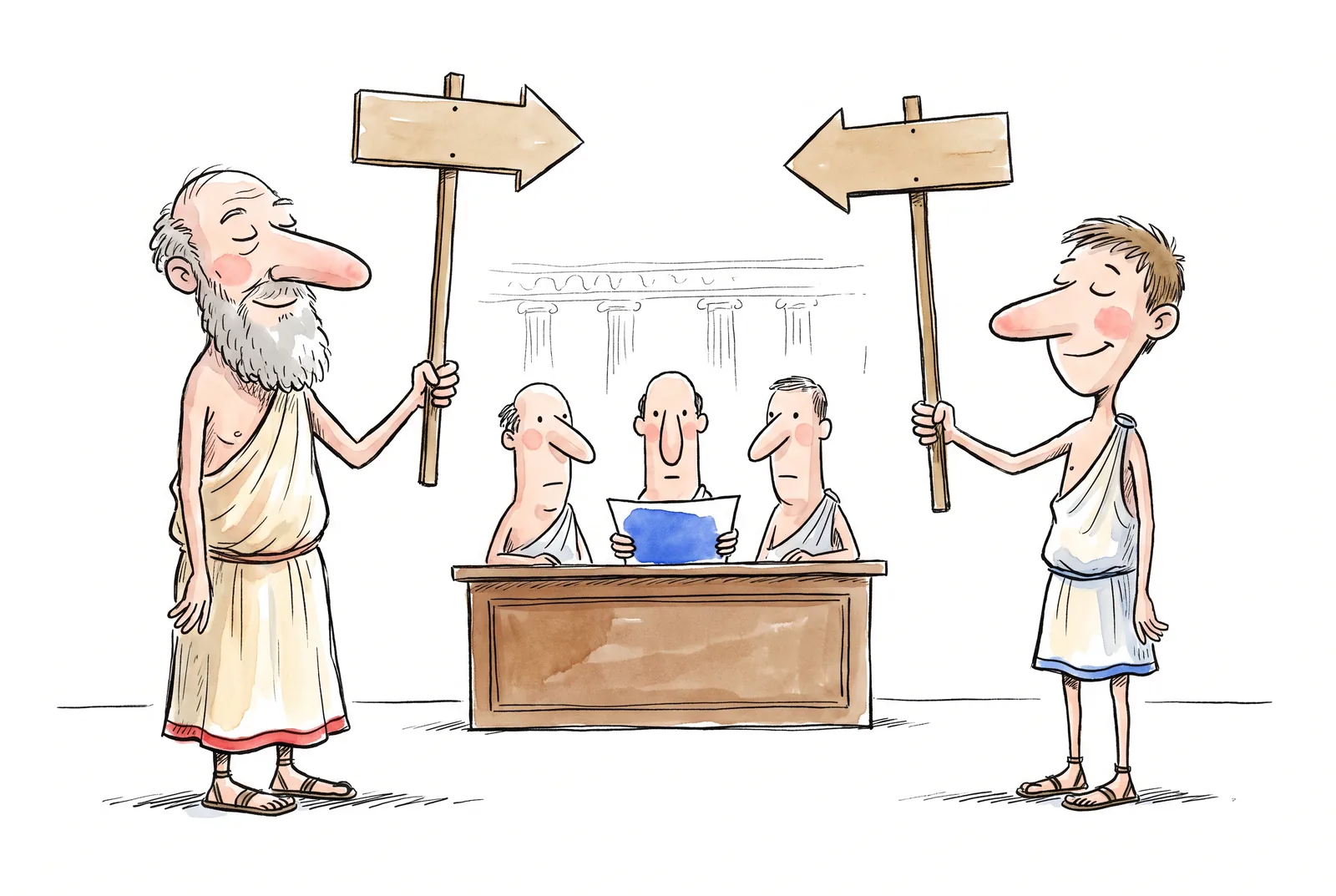
None of that is a verdict. No court decided this case, Gellius’s judges least of all, and nothing proves that any court would decide it the way the model does. What the machine did was smaller and more useful: it took “it depends” and said on what. On a reading of the contract. On whose speech is counted. On whether the verdict came before the claim or in it. Each of those is a place where the person who wrote the model made a choice, and each is a place where you can now push back with a reason instead of a feeling. The judges put the case off to a very distant day. It is still there, and it now has a map.