
Books / Law as Code in Practice: French Family Benefits / Chapter 12
Part IV · Chapter 12
Remission of a Debt, Prior Review and Deadlines

Contents of Law as Code in Practice: French Family Benefits
By the end you can route a request to the right procedure and distinguish a deadline from a favourable decision.
Lawyer: remission, prior review and recovery dispute.
Analyst: acknowledgement and notification dates.
Developer: deadline questions and argumentation are separate outputs.
The Fontaines’ question
“We accept that the housing debt exists, but cannot repay it. Is asking for a waiver the same as disputing the debt?” Predict whether all challenges use the same timetable.
We follow a different fictional family, the Fontaines, in the file FontaineRemise, dated 15 April 2026. It is not the Garniers’ three-child file with an age supplement from Chapter 4. Remise gracieuse → discretionary remission → demande_remise_gracieuse; recours administratif préalable obligatoire → mandatory prior administrative review → RAPO; commission de recours amiable → amicable review commission → CRA.
The pinned text
Article R. 825-3 CCH, edition applicable in April 2026, begins with a remission request:
sans que soit contesté le bien-fondé de la dette
English gloss: without contesting whether the debt is well-founded. The paying body acknowledges it within fifteen days of receipt; the director has two months to notify the decision, after the CRA’s opinion. The text also makes silence after that period an implied rejection and permits judicial challenge of that decision without prior administrative review. Do not transfer those rules to every appeal against a housing decision.
Two deadline rules
rule AccuseDueRemise(m: Menage, demande: Date) strict {
    when demande_remise_gracieuse(m, demande) and dette_bien_fonde_non_conteste(m);
    then accuse_due_avant_remise(m, add_calendar_period(demande, 15 calendar_day));
}

rule StatuerDueRemise(m: Menage, demande: Date) strict {
    when demande_remise_gracieuse(m, demande) and dette_bien_fonde_non_conteste(m);
    then statuer_due_avant_remise(m, add_calendar_period(demande, 2 calendar_month));
}
Labels and source anchors are left out. Both rules require the uncontested-debt fact. The case explicitly selects the calendar policy and uses 15 April as the request date. Reading the resulting dates as legal deadlines assumes that the paying body received the request that day.
| Procedural question | Recorded answer |
|---|---|
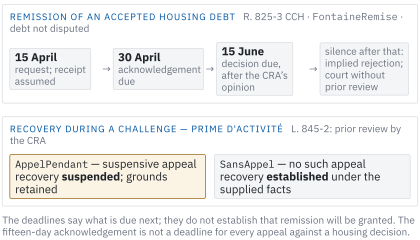
| FontaineRemise: acknowledgement deadline, assuming receipt on 15 April | 30 April 2026, established |
| FontaineRemise: decision deadline | 15 June 2026, established |
| AppelPendant: PA recovery with a suspensive appeal | Suspension of recovery established; grounds retained |
| SansAppel: PA recovery without that appeal | Recovery established under the supplied facts |
Recorded on 11 October 2026 with law 0.1.12. The last two rows are separate fictional prime-d’activité files. They concern recovery during challenge, not a CRA decision about the substantive merits. The deadlines do not establish that remission will be granted.
Change one thing
Compare AppelPendant with SansAppel in the overpayment-appeal scene, recorded on 9 October 2026. The suspensive appeal changes the grounds for proceeding with recovery. The scene’s argument graph retains reasons and priority; it does not impersonate the commission’s decision.
RAPO names a mandatory administrative review before court proceedings; CRA names the commission involved. For housing decisions under R. 825-1 and R. 825-2, the review goes through the CRA and the director gives a reasoned decision after its opinion. For prime d’activité, L. 845-2 requires prior review by the CRA. An uncontested housing-debt remission request follows R. 825-3. The recovery examples examine whether collection is suspended; they do not decide the underlying dispute.
What this gives the fund
The file can show which procedure applies, what is due next and the grounds that affect recovery. A caseworker sees a request awaiting a director’s decision separately from a challenge that affects collection. This helps prevent a fifteen-day acknowledgement rule from being used as a universal appeal deadline.
Where Catala stands on this
Catala makes conditions and exceptions explicit and reports a conflict when competing applicable definitions lack an exception relationship (Catala book, ch. 2.2). Arxo builds normative positions and argumentation queries into its model; Catala 1.3.0 has no dedicated built-in form for those procedural positions or an argument graph retaining competing grounds. Applications can define their own review workflow. For the fund, the same file can retain what action is due and why recovery is supported or defeated, without presenting those computational answers as the commission’s substantive decision.
Recording the questions
From a local checkout with law installed, start at the repository root:
cd corpus/laws/fr/apl/examples/recours-remise-fontaine
law ask . --case FontaineRemise --query-json queries/FontaineRemise-remise-receipt.json --out "$(mktemp -d)"
cd ../../../prime-activite/examples/recours-indu-cra
law ask . --case AppelPendant --query-json queries/AppelPendant-argumentation.json --out "$(mktemp -d)"
Both local packages include recorded questions, declared tests and procedural notes. A human must qualify the family’s request and review the legal grounds.
Exercise
- Does R. 825-3 here concern a dispute over whether the debt exists?
- Does the two-month deadline establish a successful remission?
- Does the appeal scene decide the merits for the CRA?