
Books / Law as Code in Practice: French Family Benefits / Chapter 10
Part IV · Chapter 10
Duties of the Fund and the Household

Contents of Law as Code in Practice: French Family Benefits
By the end you can distinguish a duty that exists from a duty whose performance has been established.
Lawyer: who owes what to whom.
Analyst: the evidence needed to assess performance.
Developer: creation and assessment of a normative position.
The Garniers’ question
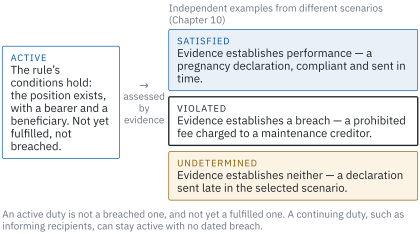
“We have an amount. What must we do, and what must the fund do?” Predict whether a duty shown as active means it has already been fulfilled.
Obligation → duty → a declared duty position. In the Garniers’ recorded files, JoindrePiecesJustificatives concerns supporting documents; PayerAfNet concerns payment of net family allowances; InformerAllocataires concerns information; JustifierChangements concerns a request for review after a change. Chapter 9 adds VerserAideTheoriqueDue after the authority establishes decency.
The text
Article L. 583-1 CSS, pinned edition applying in April 2026, says:
Les organismes débiteurs des prestations familiales et leur personnel sont au service des allocataires. Ils sont tenus en particulier : 1°) d’assurer l’information des allocataires sur la nature et l’étendue de leurs droits…
English gloss: family-benefit paying bodies and their staff serve recipients and must inform them about the nature and extent of their rights. This is a continuing obligation; the model does not invent a single deadline for it.
In the model
rule DevoirInformer(o: Organisme, p: Personne) strict {
    effective [@2021-01-01, infinity);
    when organisme_debiteur_pf(o, p);
    then duty InformerAllocataires {
        bearer o;
        beneficiary p;
        maintain information_fournie(o, p) during [@2021-01-01, infinity);
    };
}
Labels and source anchors are left out. The position names the bearer, beneficiary and what must be maintained. Its existence follows from the paying-body relation; the existence of a duty is a different question from whether evidence establishes its performance.
The recorded positions
| File or scenario | Position | Recorded state |
|---|---|---|
| Garnier April | Supporting documents, AF payment, information | Active |
| Garnier May | Justify the change with the review request | Active |
| Decency recognised, Chapter 9 | Pay the theoretical housing aid due | Active |
| Pregnancy declaration, compliant document and timely sending | DeclarerGrossesseEnDelai | Satisfied |
| Pregnancy declaration sent late in the selected scenario | DeclarerGrossesseEnDelai | Undetermined |
| Maintenance recovery, fee charged to creditor | NoChargeCreditor | Violated |
The Garnier positions were recorded on 11 October 2026 with law 0.1.11 in Chapters 4 and 9. The three performance scenarios were recorded on 11 October 2026 with law 0.1.12. Their facts concern different fictional people and legal dates; they are examples of assessment, not later events in the Garniers’ file.
Change one thing
Compare the timely declaration with the late-sending scenario. The late test expects undetermined, not violated. In this scenario, the evidence does not establish timely performance or explicit non-performance, so the expected assessment is UNDETERMINED. The maintenance example supplies the prohibited fee event, which establishes a violation.
What this gives the fund
An amount and a duty can be reviewed together without treating payment as already made. The file identifies who must act, towards whom and which evidence supports an assessment. A continuing information duty can remain visible even when no dated breach is established.
Where Catala and L4 stand on this
Catala brings legal text, exceptions and computation together, with tests available for the result (Catala book, ch. 3.3). Arxo builds duty and prohibition declarations and their assessment states into the language; Catala 1.3.0 has no dedicated built-in deontic position form. L4, a rules language from Legalese, also provides built-in obligations, permissions and prohibitions through MUST, MAY and SHANT, with FULFILLED and BREACH outcomes (official L4 documentation). For this fund example, the benefit calculation and the obligations of both sides can be inspected in the same answer, while performance remains dependent on evidence.
Record the performance scenarios
From a local checkout with law installed, start at the repository root:
law test corpus/laws/fr/pf-paje --file tests/devoir-declarer-satisfait.lawtest --json
law test corpus/laws/fr/pf-paje --file tests/devoir-declarer-envoi-tardif.lawtest --json
The maintenance scenario belongs to the canon fr.pf.maintenance and was recorded with its prohibition and facts as the canon declares them.
Exercise
- Does active mean satisfied?
- Does the displayed late-sending scenario establish a violation?
- Which duty is continuing rather than assigned a single deadline here?