
Books / Law as Code in Practice: French Family Benefits / Appendix A
Appendix A
The Answer Card and Its Statuses
Contents of Law as Code in Practice: French Family Benefits
Every answer in this book comes from one question asked of the model about one file on one date. The chapters show it as a table row or a short excerpt; behind it is a saved answer document. This appendix lists what that answer carries and the statuses the book uses.
The answer card
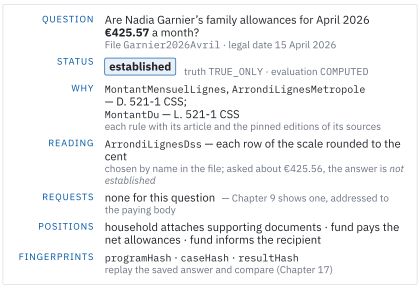
Every volume of this series shows a decision on the same card: the question, the legal date, the answer with its status, the claim or right where there is one, the decisive provisions, the sources, the readings applied, the open questions and the fingerprints. The figure above picks out parts of one answer as the model returns it. The card below gives the same answer — the Garniers’ family allowances for April 2026, as Chapter 4 shows it — in the series’ common form:
| Question | Are Nadia Garnier’s family allowances for April 2026 €425.57 a month? File Garnier2026Avril |
| Legal date | 15 April 2026 — the editions in force that day |
| Answer | €425.57 a month — established; asked about €425.56 under the same reading, not established |
| Claim | the amount due, €425.57 a month — established (MontantDu); the fund’s duty to pay the allowances net of CRDS, €423.44215, is active (PayerAfNet) |
| Decisive provisions | D. 521-1 CSS — the rates for three children and one age supplement, line by line (MontantMensuelLignes, ArrondiLignesMetropole); L. 521-1 CSS — the amount due |
| Sources | D. 521-1 and L. 521-1 CSS in their pinned editions; the BMAF of €478.16, entered from the yearly instruction DSS/2B/2026/46 |
| Readings applied | ArrondiLignesDss — each row of the yearly instruction’s scale rounded to the cent (Chapter 4) |
| Open questions | no request to an authority in this answer; the rounding reading is declared disputed, and the number of age supplements — one, for Inès — is a fact of the file |
| Fingerprints | not saved for this card; the scenario famille-trois-enfants-loyer.lawtest in the Garnier case package reproduces it with law test; Chapter 17 shows a saved answer with its fingerprints |
The card is a summary for a reader. The table below lists the parts of the saved answer it is drawn from, and the chapter where each is first shown.
What an answer carries
| Part | What it says | First shown |
|---|---|---|
| The question | the statement or amount asked about, the file and its legal date | Chapter 2 |
| Truth status | whether the facts and rules support the statement, its opposite, both or neither | Chapter 2 |
| Evaluation status | whether the model could answer, and if not, why | Chapter 5 |
| Rules and articles | each rule applied, with the article behind it and the pinned editions of its sources | Chapter 4 |
| Reading | the reading the file chose by name where a text can be read more than one way | Chapter 4 |
| Requests | a question the rules reserve for an authority, with its addressee | Chapter 9 |
| Positions | duties, powers and freedoms in force, with who holds them, towards whom, and their state | Chapter 4 |
| Fingerprints | the programme, case and result hashes that let the answer be replayed | Chapter 17 |
Truth status
| Status | In this book | Meaning |
|---|---|---|
TRUE_ONLY |
established | The facts and rules support the statement and do not support its opposite. |
FALSE_ONLY |
refuted | They support the opposite and do not support the statement. Not met in this book. |
NEITHER |
not established | They support neither. This is not zero and not a refusal: often a fact is missing, and the model names the open premise. |
BOTH |
contradiction | They support both. The answer keeps both, with their sources, for review instead of choosing silently. Not met in this book; Volume 2 shows one (Chapter 8). |
Evaluation status
The truth status says what follows; the evaluation status says whether the model could answer at all. The book meets four.
| Status | In this book | Meaning | Chapter |
|---|---|---|---|
COMPUTED |
computed | The answer was computed; read its truth status. | 5 |
REQUIRES_JUDGMENT |
requires judgment | The rules reserve a question for an authority. The answer carries a request naming the question and the authority — for decent housing, the paying body. | 9 |
INTERPRETATION_REQUIRED |
a reading must be chosen | The answer depends on a group of readings, and the file has not chosen one. A question that does not depend on the group is answered as usual. | 8 |
RUNTIME_ERROR, cause INEXACT_DIVISION |
refused | A division has no finite decimal result and no reading says how to round it. The model stops instead of choosing a rounding for you. | 4, 7 |
Other statuses exist for situations this book does not meet, such as a missing rounding policy or a source that cannot be resolved.
States of a position
A duty, a prohibition, a power or a freedom is a position: it has a holder, a counterparty and a state. The book uses four states.
| State | Meaning | Chapter |
|---|---|---|
| active | The rule’s conditions hold: the position exists. An active duty is neither fulfilled nor breached yet. | 4, 9, 10 |
| satisfied | Evidence establishes that the duty was performed. | 10 |
| violated | Evidence establishes a breach. | 10 |
| undetermined | Evidence establishes neither performance nor breach. | 10 |